| | Hello ESTers!
Welcome back to InsideMENA, your bi-monthly snapshot of the key political, social, and cultural developments shaping the Middle East and North Africa, with an eye on Europe and the wider world.
As always, we’re bringing you concise analysis and fresh perspectives from across the region, along with InsideCulture, our dedicated space for music, film, writing, and digital voices that spotlight the stories and creativity shaping everyday life across the MENA region.
And for those who celebrate — Happy Easter!
Ready to dive in? Let’s go InsideMENA!
P.S. Reading this on our website? Subscribe to get InsideMENA straight to your inbox every fortnight.
Edited by Clarice Agostini and Jesse Woche Note that the information, views and opinions set out in the newsletter are those of the authors and do not necessarily reflect the opinion or position of the editors, of the European Student ThinkTank, and of their affiliated entities or institutions.
|
|
Settler Violence Increasing in the West Bank By Hannah
|
|
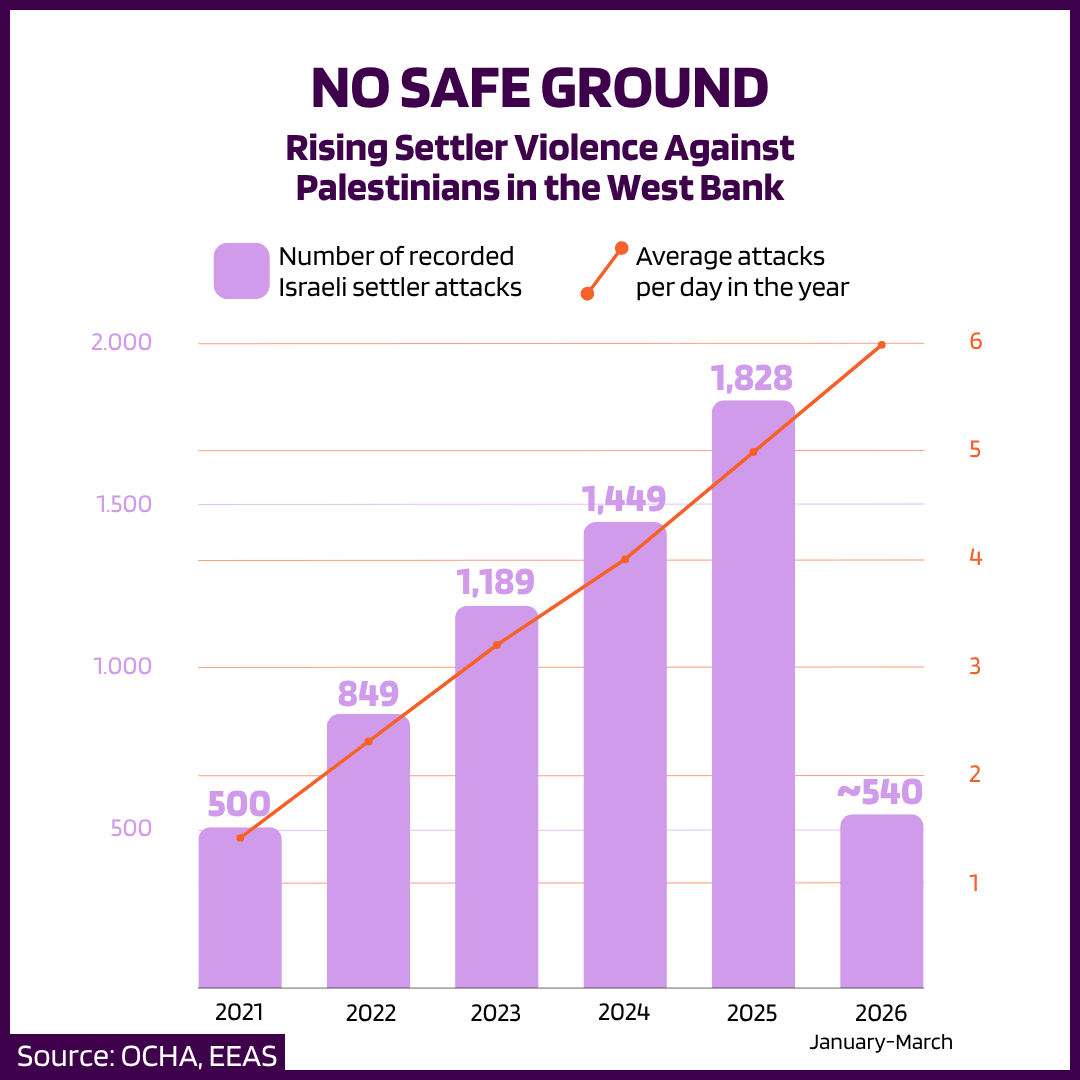
A Surge in Violence. Since the US and Israel began bombing Iran, there have been a number of attacks on Palestinian villages in the occupied West Bank, including setting fire to homes, vehicles, and agricultural fields. Since March 1st, six Palestinians have been killed by settlers.
Complicity. Importantly, no preventative measures were put in place to avoid the violence, despite what Yesh Din, an Israeli civil rights group that seeks to protect the rights of Palestinians, described as prior knowledge of the planned attacks, and what witnesses described as coordinated raids. Equally, Israeli troops and police, despite being present, did not put an end to the attacks or prevent settlers from moving between villages.
Continuation of Historical Trends. Within the occupied West Bank and East Jerusalem, Israel has built around 160 settlements housing 700,000 Israeli Jewish people, all of which are illegal under international law. This is not the first time that Palestinians have faced violence by the settler community, and since the beginning of the genocide in Gaza, Israeli forces and settlers have killed over 1000 Palestinians in the West Bank.
|
|
Iranians and Forced Internet Blackouts By A Voice from Iran |
|
Nowruz and Internet Blackouts. As Nowruz (Iran’s New Year's Day) began, many families in Iran faced the new year in silence. Internet shutdowns by Iran’s government, ongoing since February 28th, made it difficult or impossible to call relatives, send messages, follow the news, or share updates about safety. At a time that is usually centred on family, visits, and celebration, many people were left with worry, isolation, and uncertainty. The blackout not only blocked communication, but it also deepened the emotional cost of the war, turning a national holiday into a period of fear and separation.
Criminalisation of Starlink. The pressure is growing in new ways. Authorities have targeted people using satellite internet through Starlink, blocked dozens of accounts, seized equipment, and detained several users as part of a wider crackdown. With normal internet access almost completely cut off, even alternative ways of getting online are now becoming riskier. For many people, the blackout is no longer only about silence and isolation. It is also about fear, surveillance, and the danger of punishment for trying to stay connected. Internet monitoring group “NetBlocks” reports that internet connectivity has fallen to roughly 1% of its usual level, with satellite services remaining one of the only ways to stay connected globally. |
|
Bridging Voices: Rethinking EU–Sahel Relations in a Post-Coup Context By Jordi |
|
From Strategic Reassessment to Political Re-Engagement. A gradual but notable shift is emerging in the European Union’s approach to the Sahel, moving beyond a predominantly security-driven model toward a more politically grounded and locally attuned engagement. Search in Common Ground, an international NGO working to end violent conflict, increasingly calls for a reset based on dialogue, sovereignty recognition, and alignment with post-coup realities in Mali, Burkina Faso, and Niger.
A Fragmented but Converging Policy Shift. While no single framework formally defines this transition, converging signals from diplomatic, media, and policy circles point to an ongoing recalibration. The erosion of traditional Western military influence, combined with the rise of alternative partnerships, has prompted European actors to reassess their leverage. This is reflected in a growing emphasis on political engagement, development cooperation, and pragmatic dialogue with de facto authorities, marking a departure from earlier approaches centred on conditionality and security assistance.
The Way Forward. This evolution appears both necessary and incomplete, calling for a structured transition toward a more balanced partnership that integrates Sahelian agency while maintaining principled engagement.
|
|
Türkiye Continues De-Escalation Efforts at Critical Iran Meeting in Islamabad By Isabella |
|
Talks in Islamabad, Ankara in the Mix. Türkiye is doubling down on its diplomatic push as it joins a critical round of talks in Islamabad aimed at calming the Iran crisis. While Pakistan has taken the lead in organizing and hosting the meetings, Ankara is increasingly positioning itself as an active partner in these ceasefire efforts. Foreign Minister Hakan Fidan said the goal is to establish a concrete mechanism for de-escalation, as regional actors search for ways to halt the conflict and stabilize key energy and trade routes.
Not Watching from the Sidelines. There are growing indications that Ankara is seeking a role within the Pakistan-led ceasefire efforts, rather than staying on the margins. Analysts point to a developing alignment between Pakistan, Egypt, and Turkey, all working to broker a middle ground and push toward a ceasefire. The content of the meeting has not yet been released to the public.
Erdoğan Sharpens Tone. At home, President Recep Tayyip Erdoğan has taken a firmer stance. Speaking at a party meeting, he accused the Netanyahu government of expanding its military actions beyond Iran, pointing to developments in Lebanon and ongoing violations of Syrian sovereignty. Erdoğan also called on regional countries to act in unity, framing the crisis as a broader threat to regional stability. |
|
|
| |
| |
|