The latest news from SEFI and the engineering education community
͏ ͏ ͏ ͏ ͏ ͏ ͏ ͏ ͏ ͏ ͏ ͏ ͏ ͏ ͏ ͏ ͏ ͏ ͏ ͏ ͏ ͏ ͏ ͏ ͏ ͏ ͏ ͏ ͏ ͏ ͏ ͏ ͏ ͏ ͏ ͏ ͏ ͏ ͏ ͏ ͏ ͏ ͏ ͏ ͏ ͏ ͏ ͏ ͏ ͏ ͏ ͏ ͏ ͏ ͏ ͏ ͏ ͏ ͏ ͏ ͏ ͏ ͏ ͏ ͏ ͏ ͏ ͏ ͏ ͏ ͏ ͏ ͏ ͏ ͏ ͏
| Monthly news feed about engineering education in Europe and overseas |
|
|
| |
|
|
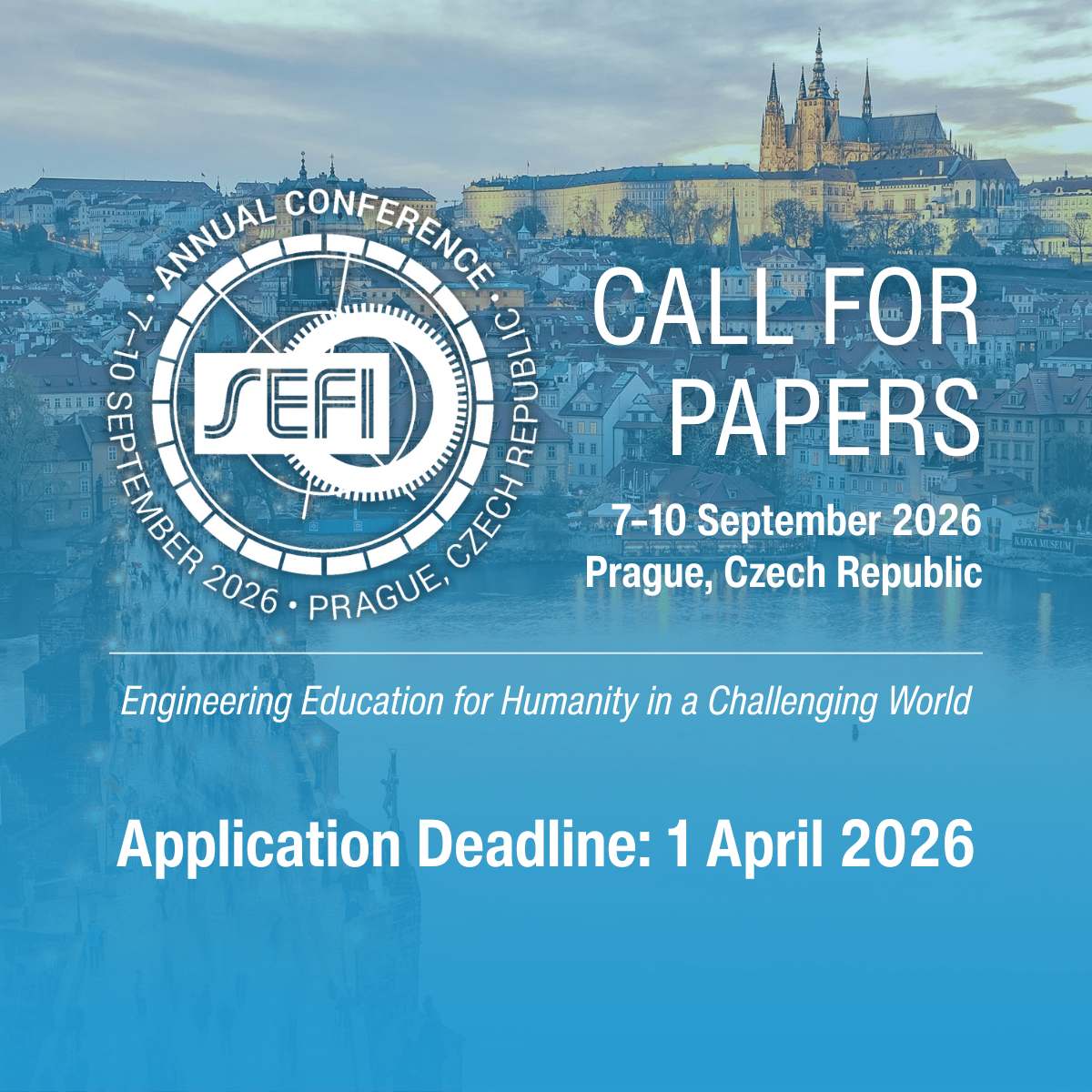
| Call for Papers: Engineering Education for Humanity in a Challenging World |
|
💡 Submissions open: 2 February 2026 🗓️ Deadline: 1 April 2026
The 54th SEFI Annual Conference invites contributions exploring how engineering and scientific practice can be more closely aligned with human values. In today’s complex global context, addressing societal challenges demands interdisciplinary approaches that integrate engineering with the social sciences, humanities, and ethics. By emphasising humanity in engineering, the conference seeks work that advances technological innovation while remaining socially responsible, culturally sensitive, and sustainable. |
|
|
| |
|
|
| Call for Editor-in-Chief for the European Journal for Engineering Education |
|
🗓️ Application deadline: 15 April 2026
SEFI is seeking a new Editor-in-Chief (or co-Editors-in-Chief) for the European Journal of Engineering Education, SEFI's flagship peer-reviewed journal and a leading international outlet for engineering education research. The role constitutes: A four-year term starting 1 January 2027 (with transition during 2026) Approximately one day per week Editorial independence and leadership of an established international editorial team
We welcome applications from colleagues who are well established in engineering education research, have editorial and reviewing experience, and are employed at a SEFI member institution.
|
|
|
| |
|
|
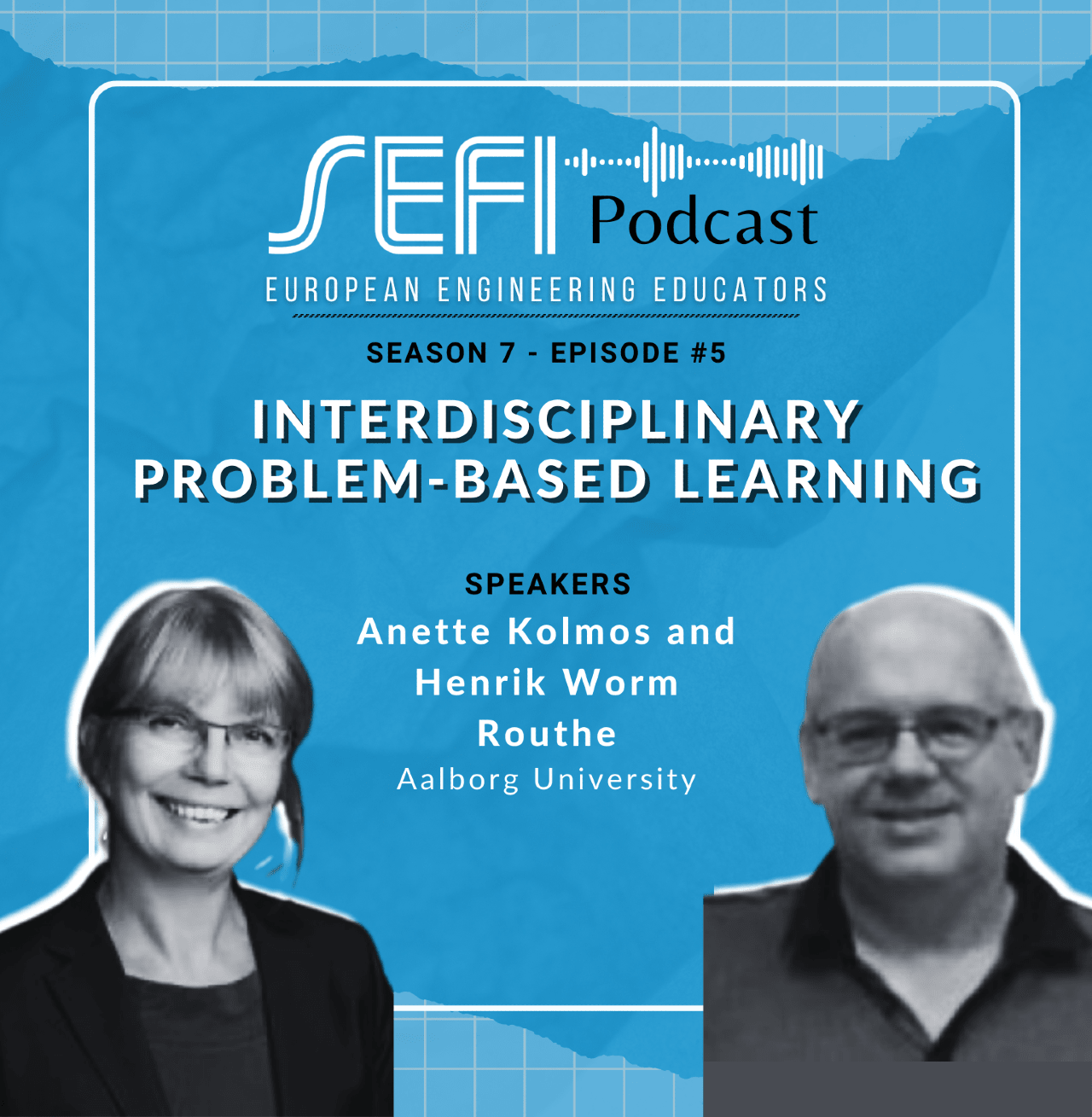
| SEFI Podcast Season 7 Episode 5 – Anette Kolmos and Henrik Worm Routhe on Interdisciplinary Project-Based Learning |
|
The rising complexity of modern societal challenges has intensified interest in interdisciplinary engineering education.
In this episode we speak to Anette Kolmos (Professor in Engineering Education and PBL) and Henrik Worm Routhe (Postdoctoral Researcher) from Aalborg University in Denmark, about InterPBL and the different approaches to interdisciplinary learning and teaching.
|
|
|
| |
|
|
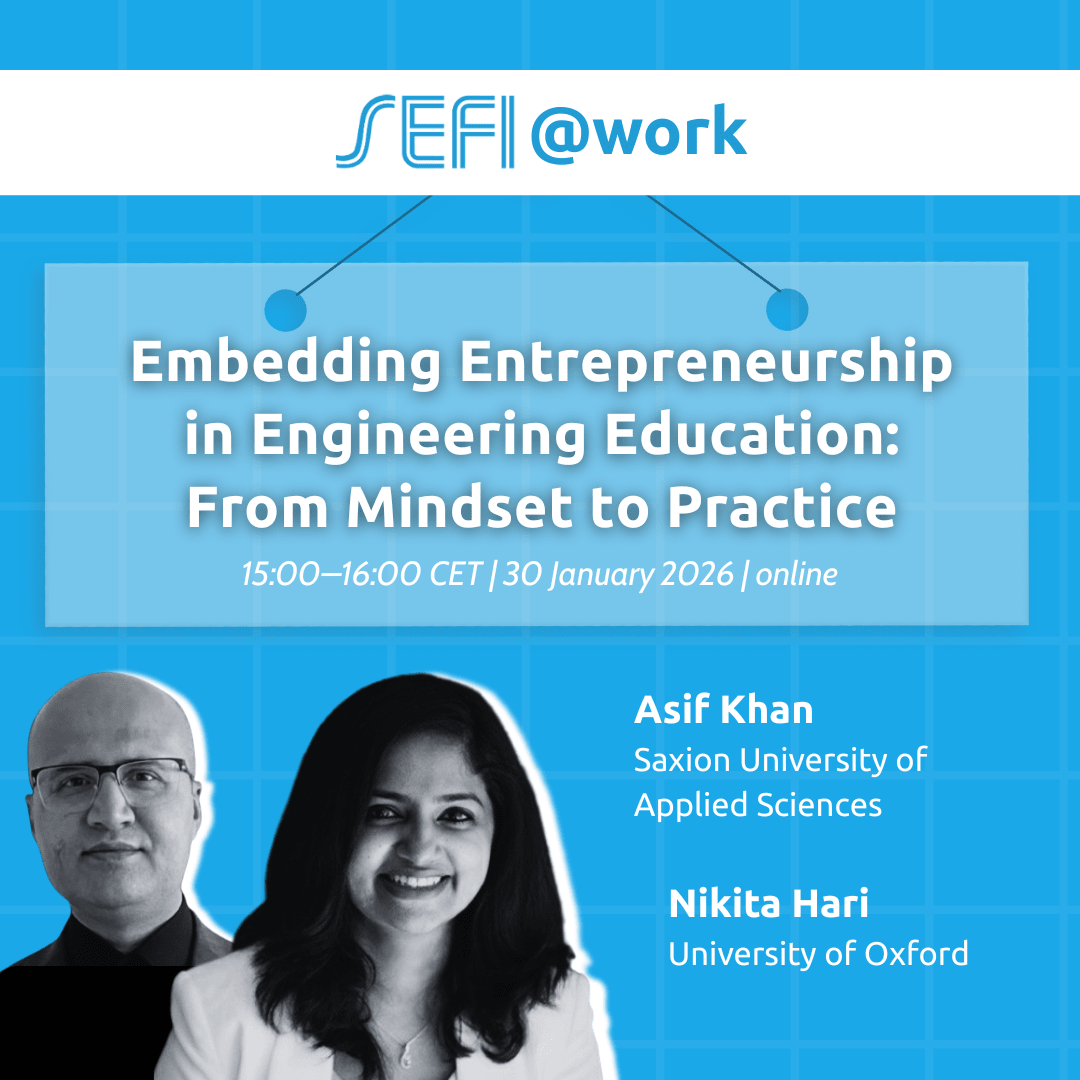
| Embedding Entrepreneurship in Engineering Education: From Mindset to Practice |
|
🗓️ 30 January 2026, 15:00–16:00 CET
Engineering educators are increasingly expected to help students develop not only technical expertise, but also the mindset and practical capability to turn ideas into action—across disciplines, in collaboration with industry, and within complex real-world contexts. This webinar invites a shared exploration of how entrepreneurship can be embedded within engineering education, moving from aspiration and mindset to everyday teaching practice.
This SEFI@work is brought to you by the SEFI Special Interest Group on Entrepreneurship. |
|
|
| |
|
|
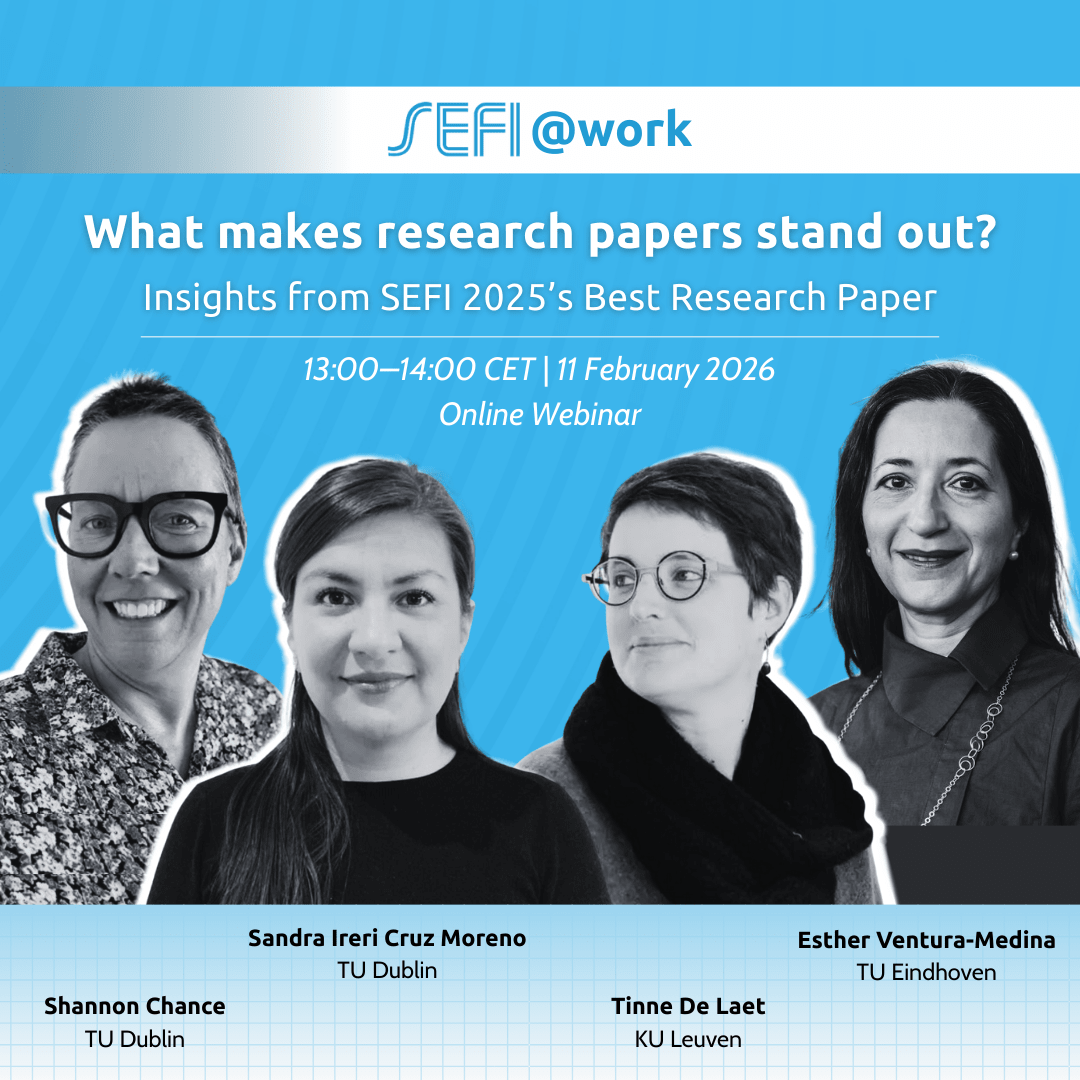
| What makes research papers stand out? Insights from SEFI 2025’s Best Research Paper |
|
🗓️ 11 February 2026, 13:00–14:00 CET
Join the SEFI Engineering Education Research Special Interest Group for an inspiring SEFI@work session just in time for the launch of the Call for Papers for the SEFI 2026 Annual Conference!
Learn directly from the award-winning authors of the Best Research Paper at SEFI 2025 as they share what makes a research paper stand out, especially on a topic focusing on gender dynamics! This session will go beyond methodology—exploring challenges, design choices, and practical recommendations from the authors themselves: Sandra Ireri Cruz Moreno and Shannon Chance (TU Dublin). |
|
|
| |
|
|
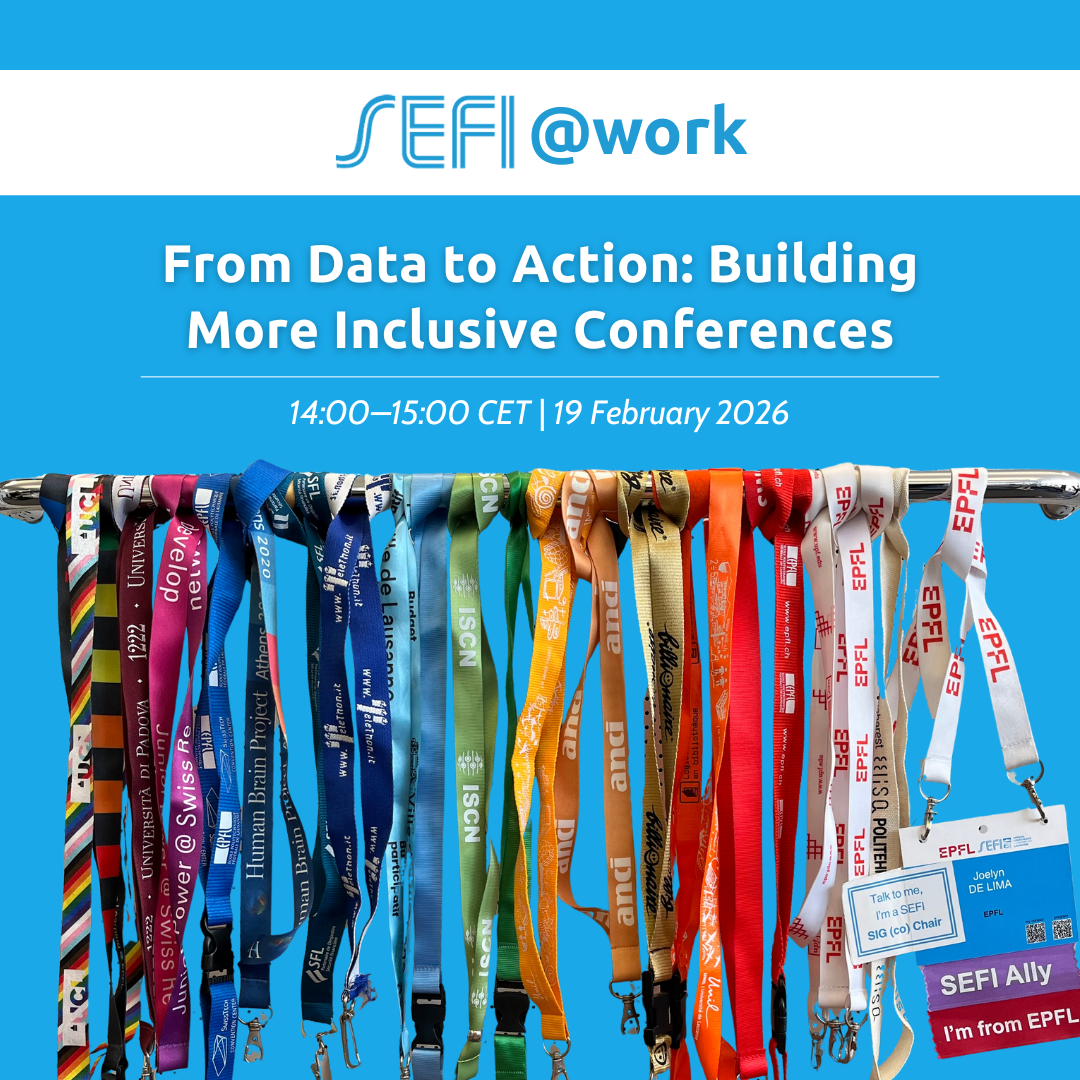
| From Data to Action: Building More Inclusive Conferences |
|
🗓️ 19 February 2026, 14:00–15:00 CET
Academic conferences like the SEFI Annual Conference are vital for advancing engineering education, fostering scholarly exchange, networking, and career progression—especially in emerging fields such as engineering education research. This SEFI@work session shares findings from a study on inclusion at SEFI conferences, exploring barriers to participation and perceptions of diversity efforts.
This SEFI@work is brought to you by the SEFI Special Interest Group on Diversity, Equity and Inclusion. |
|
|
| |
|
|
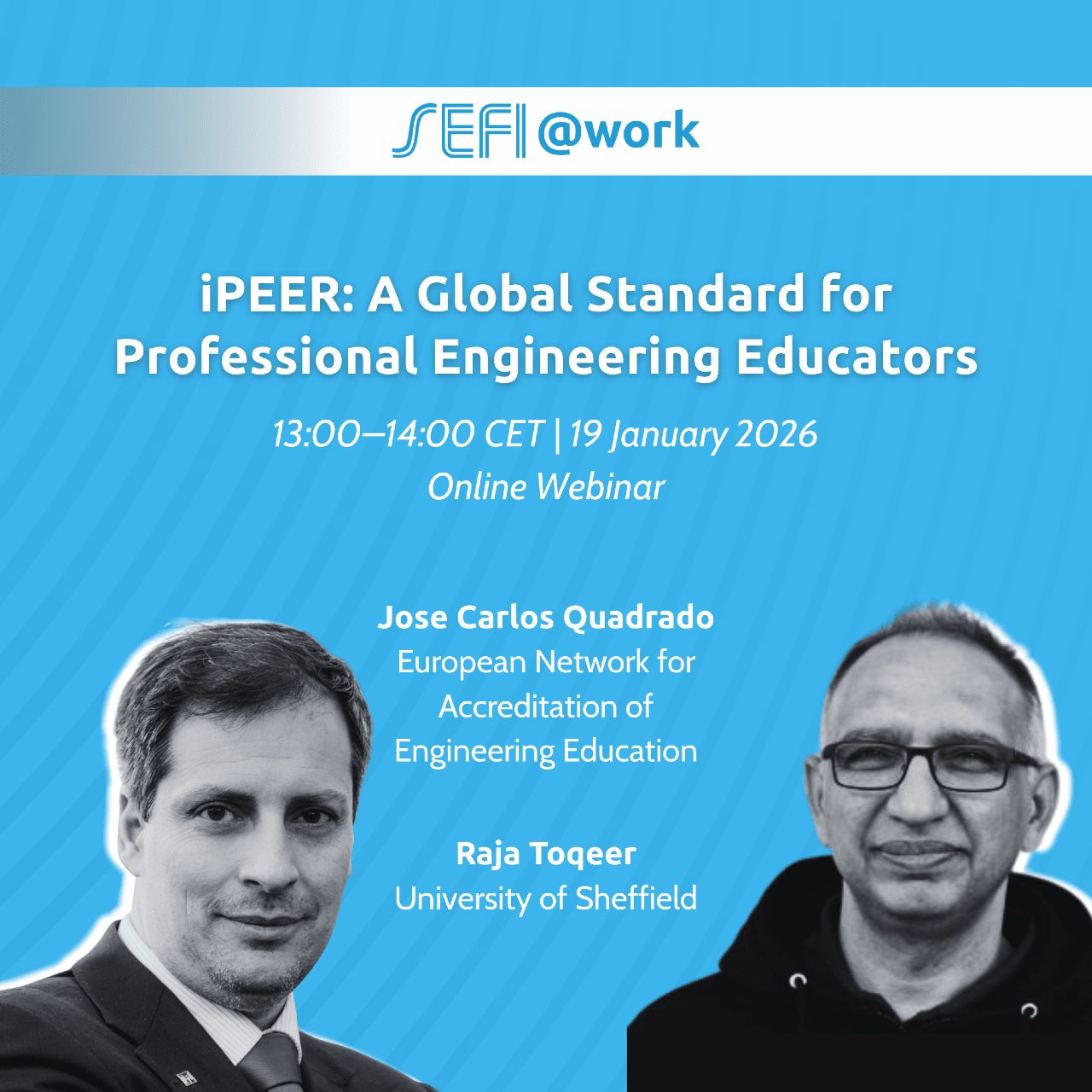
| iPEER: A Global Standard for Professional Engineering Educators |
|
At our first SEFI@work webinar of 2026, hosted by the SEFI Quality Assurance and Accreditation SIG, we were joined by Jose Carlos Quadrado (European Network for Accreditation of Engineering Education) and Raja Toqeer (University of Sheffield) of the Quality Assurance and Accreditation SIG who introduced the International Professional Engineering Educator Registry (iPEER) framework. iPEER provides an internationally recognised standard for excellence in engineering education practice, linking pedagogy, innovation, and professional identity. The recording is now available on our Youtube channel. |
|
|
| |
|
|
| Perceptions of project-based learning in CDIO-aligned curricula: an exploratory cluster analysis of a five-university survey in South Africa |
|
In a new paper in the SEFI Journal of Engineering Education Advancement, the authors explore how an unsupervised machine learning approach can be applied to understand and enhance the implementation of Project-Based Learning using the Conceive, Design, Implement, Operate framework in African engineering education. The study proposes actionable recommendations for educators and policymakers. |
|
|
| |
|
|
| Investigation of lack of engagement among students taking part in group work in engineering subjects |
|
While group work is a compulsory part of engineering courses in international universities, it is also an area of low satisfaction among both students and staff. In a new publication of the SEFI Journal of Engineering Education Advancement, researchers investigated satisfaction in engineering group work contexts, with a specific look into whether tailored intervention could be identified to improve student engagement in classroom trials. |
|
|
| |
|
|
| From Calculators to AI: A Global Education Debate |
|
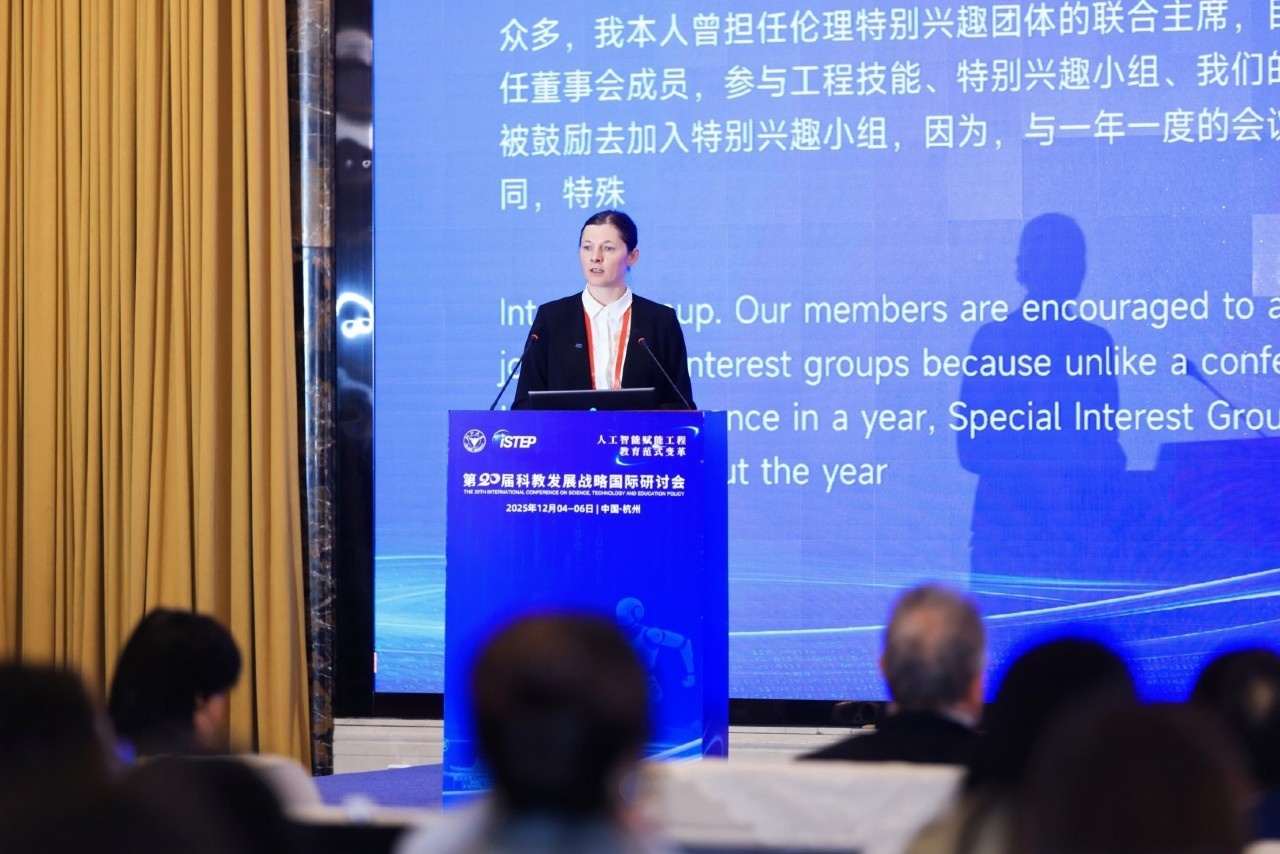
In early December, Helena Kovacs, Skills and Learning Manager at EPFL and member of the SEFI Board of Directors, was invited to deliver a keynote at the International Conference on Science, Technology, and Education Policy (iSTEP), organised by the Chinese Society for Engineering Education (CSEE) in Hangzhou, China.
Helena’s keynote addressed a question increasingly central to engineering education worldwide: how should we respond to the growing presence of artificial intelligence in teaching and learning? Drawing on insights from SEFI conference proceedings since 2020, Helena highlighted how AI has only recently emerged as a practical concern, alongside a longer-standing focus on transferable skills and an increasing convergence around a shared goal: educating responsible engineers.
|
|
|
| |
|
|
| Building International Dialogue in Engineering Ethics Education: Reflections from Japan |
|
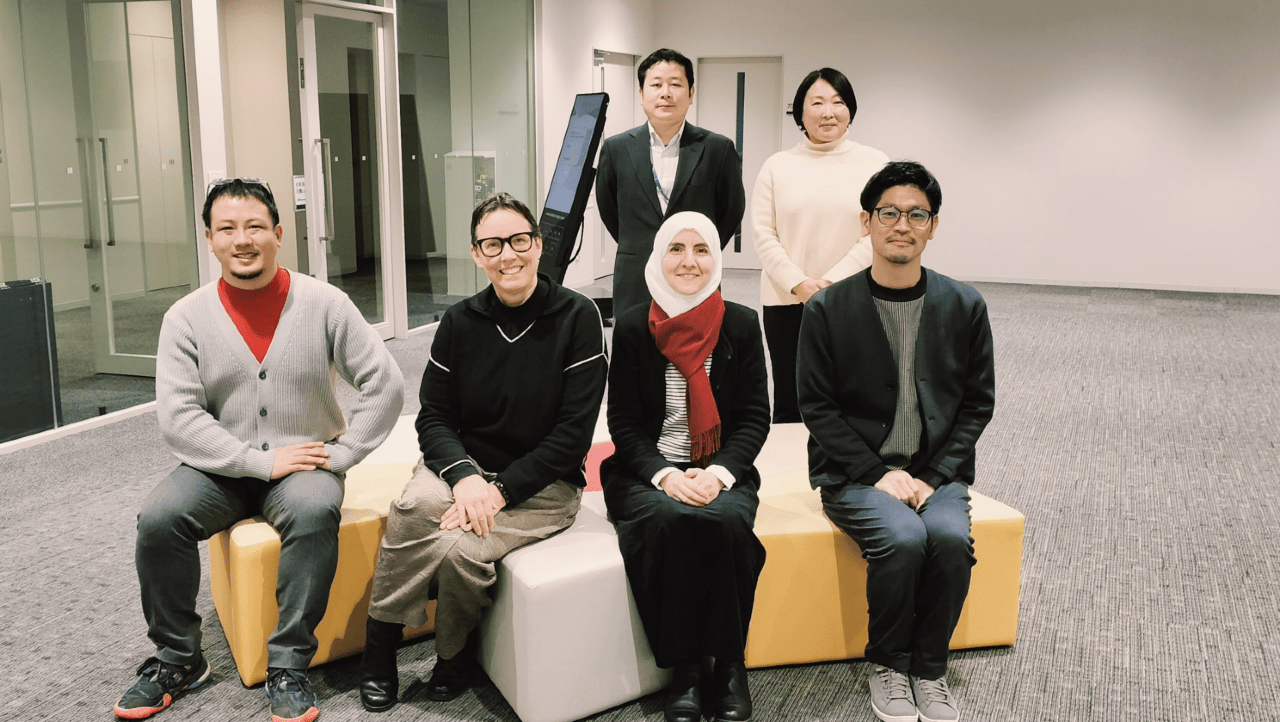
In January 2026, the Committee for Investigation and Research of Engineering Ethics of the Japan Society for Engineering Education (JSEE) hosted an international workshop at Tokyo Online University. The event welcomed Shannon Chance (TU Dublin) and Sarah Junaid (Aston University), both members of the SEFI Ethics Special Interest Group.
Their lectures made a significant contribution to the advancement of engineering ethics education in Japan. The workshop also served as a heartfelt tribute to the late Kenichi Natsume. Through this gathering, participants reaffirmed their shared commitment to carrying forward his legacy and emphasised the importance of sustained and meaningful dialogue between JSEE and SEFI in the field of engineering ethics education. |
|
|
| |
|
|
| 2026 Immersive Design Challenge |
|
🗓️ Application deadline: 2 February 2026
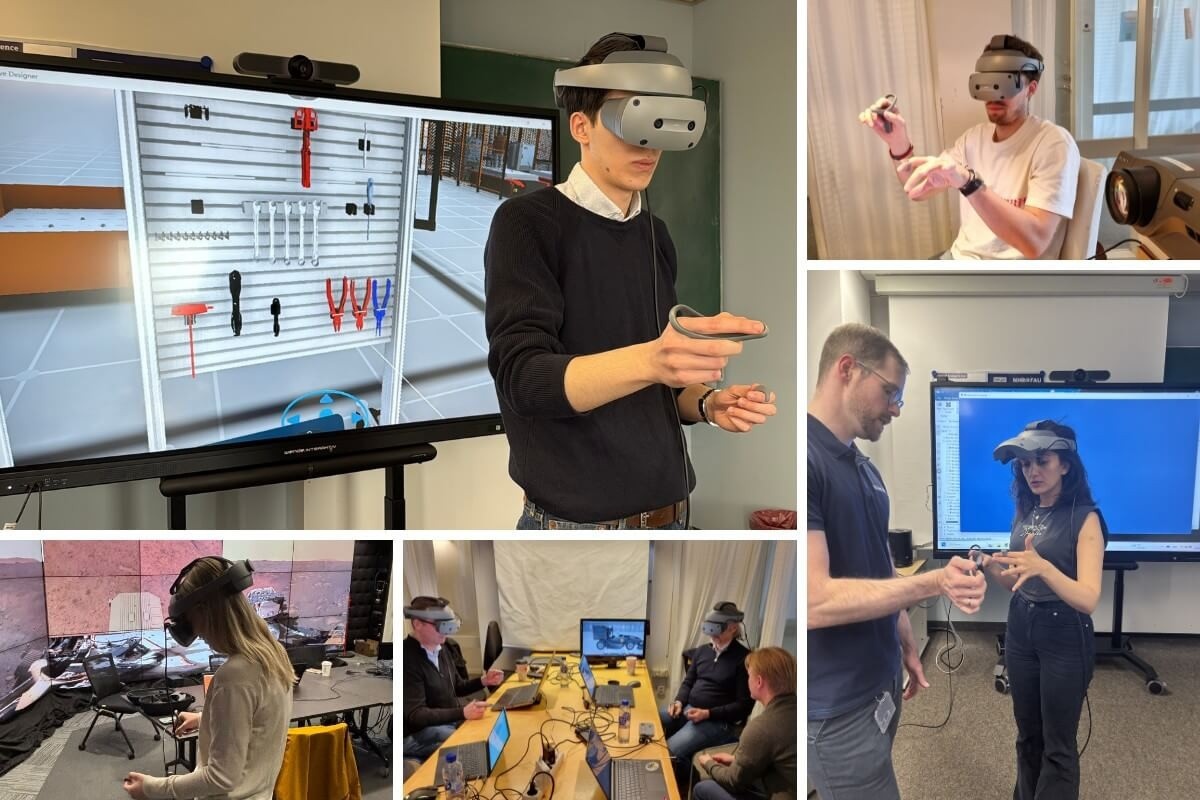
Siemens and Sony are challenging students worldwide to make a product or process more sustainable with Immersive Engineering! The challenge is open to students from any discipline enrolled in a Bachelor’s, Master’s, or PhD program and is particularly relevant for students studying CAD or a related program. This is a unique opportunity for participants to develop their skills while working in teams with industry input on a real-world challenge.
The top teams per region will showcase their ideas at Siemens Realize LIVE 2026, and the winning team’s university in each region will receive a Sony XR head-mounted display.
Round 1 closes 2 February 2026.
|
|
|
| |
|
|
| Online Course: Democratizing sustainability and strengthening democracy durably |
|
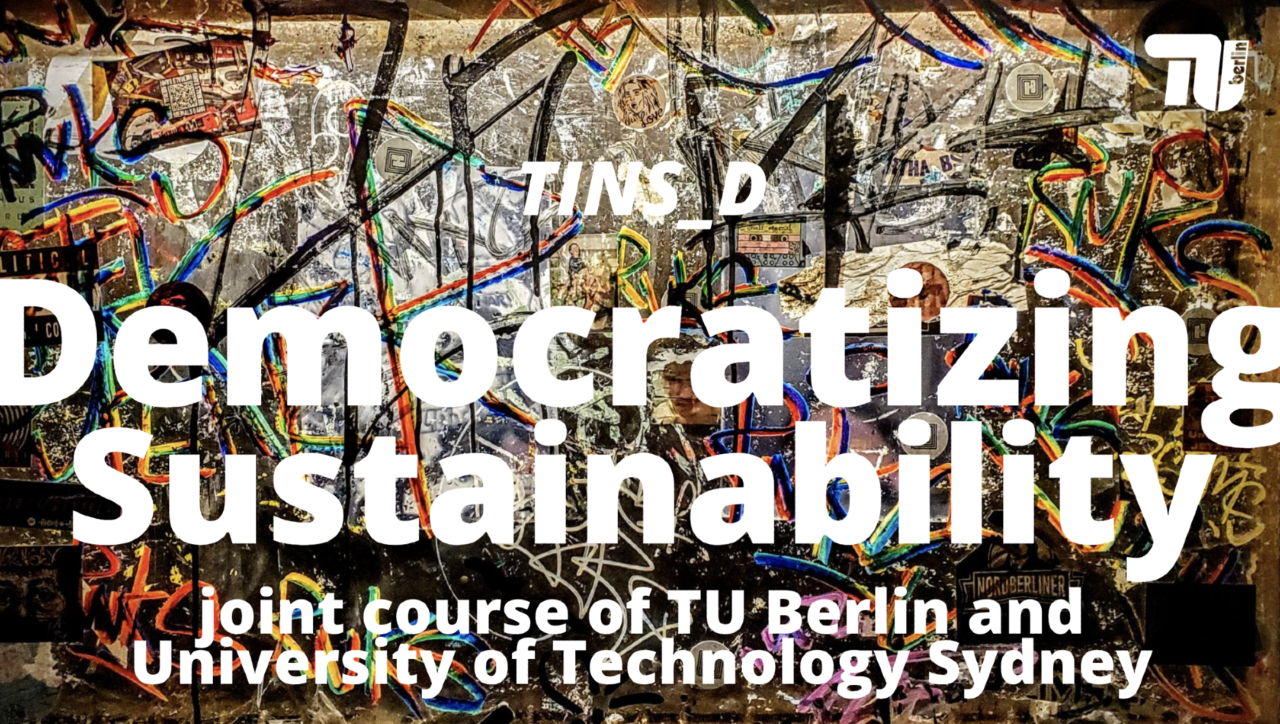
📆 16 February – 13 April 2026 🕑 9:00–11:00 CET Mondays & Wednesdays What counts more in your private and professional life — result or process? Whom do you include in decision making processes and whom do you exclude? What are you allowed to take decisions upon and what is kept beyond your reach?
This free, 6 ECTS, joint course offered by TU Berlin and University of Technology Sydney, relies entirely on the interaction of the participants to explore, practice, and reflect on what democracy is about and how we may promote it in our private and professional lives. Participants will reflect on how decisions are taken within academia and industry, learn how to change your studies and jobs from within as well as how to engage in a socio-ecological transformation, and explore ways to democratize your own private and working life together with others, even if this means entering into conflicts and resolving them together or sometimes bravely enduring them. |
|
|
| |
|
|
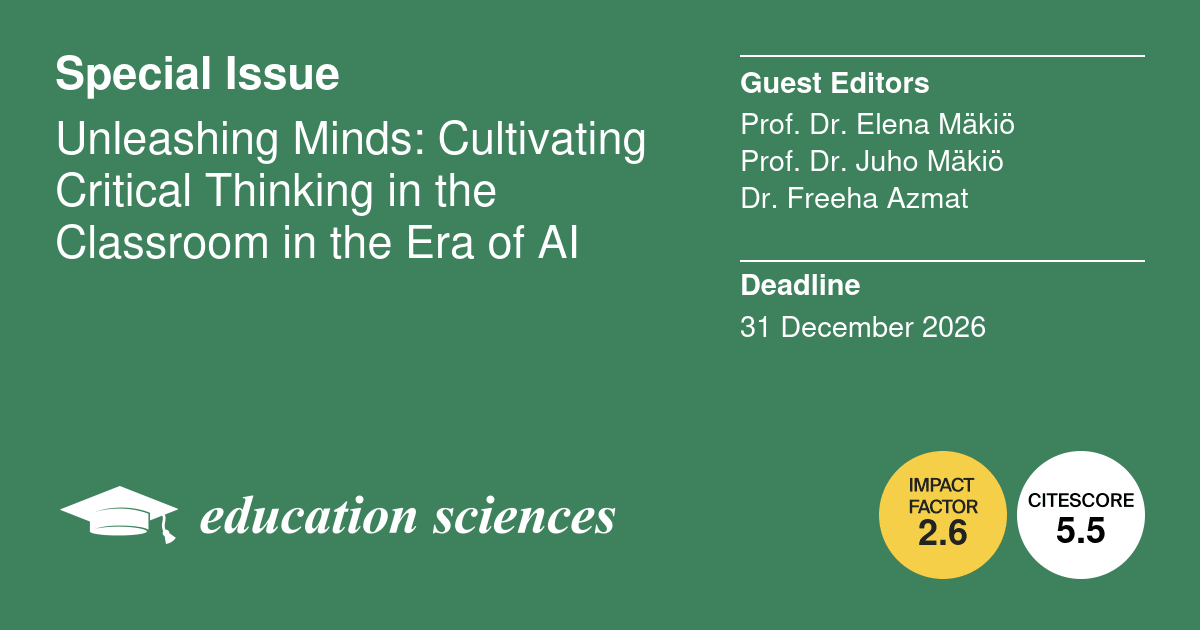
| Call for Submissions: Education Sciences |
|
📆 Submission deadline (rolling): 31 December 2026
The Education Sciences journal is publishing a special issue on the topic Unleashing Minds: Cultivating Critical Thinking (CT) in the Classroom in the Era of AI, guest edited by SEFI member Professor Elena Mäkiö alongside colleagues from other universities. The special issue is dedicated to exploring the topic of interaction between CT and AI in higher education. By embracing multiple perspectives and disciplines in higher education, they aim to develop a comprehensive understanding of how CT is fostered by the use of AI in teaching and learning and, vice versa, how CT can be applied to effectively use AI in learning and future work. |
|
|
| |
|
|
| 20–24 April 2026 Sofia, Bulgaria
|
|
|
| |
|
|
| 19–22 May 2026 Aalborg, Denmark
|
|
|
| |
|
|
| 25–27 May 2026 Gliwice, Poland
|
|
|
| |
|
|
| 27–29 May 2026 Warsaw, Poland
|
|
|
| |
|
|
| 4–5 June 2026 Istanbul, Turkey |
|
|
| |
|
|
| 19 June 2026 Aveiro, Portugal
|
|
Save the date! Empathic Engineering Education for Sustainable Development University of Aveiro
|
|
|
| |
|
|
| 6 September 2026 Prague, Czech Republic
|
|
Save the date! 10th SEFI Doctoral Symposium Czech Technical University in Prague |
|
|
| |
|
|
| 7–10 September 2026 Prague, Czech Republic
|
|
|
| |
|
|
| 13–17 September 2027 Sheffield, England
|
|
Save the date! SEFI Annual Conference 2027 University of Sheffield |
|
|
| |
|
|
| SEFI aisbl Rue des Deux Eglises 39
1000 Brussels
|
|
|
| |
|
|