| Hello ESTers!
Welcome back to InsideMENA, your bi-monthly snapshot of the key political, social, and cultural developments shaping the Middle East and North Africa, with an eye on Europe and the wider world.
As always, we’re bringing you concise analysis and fresh perspectives from across the region, along with InsideCulture, our dedicated space for music, film, writing, and digital voices that spotlight the stories and creativity shaping everyday life across the MENA region.
This week marks the beginning of Ramadan, the holy month during which Muslims fast from sunrise to sunset (including from water). We at the Observatory wish a blessed Ramadan to all who observe, and hope this month brings relief, reflection, and peace.
For those who don't celebrate, we hope this edition brings you closer to the MENA region during these extraordinary times.
Ready to dive in? Let’s go InsideMENA!
P.S. Reading this on our website? Subscribe to get InsideMENA straight to your inbox every fortnight.
Edited by Clarice Agostini and Jesse Woche Note that the information, views and opinions set out in the newsletter are those of the authors and do not necessarily reflect the opinion or position of the editors, of the European Student ThinkTank, and of their affiliated-entities or institutions.
|
|
Death of a Student During Campus Protests in Senegal
By Romane
|
|
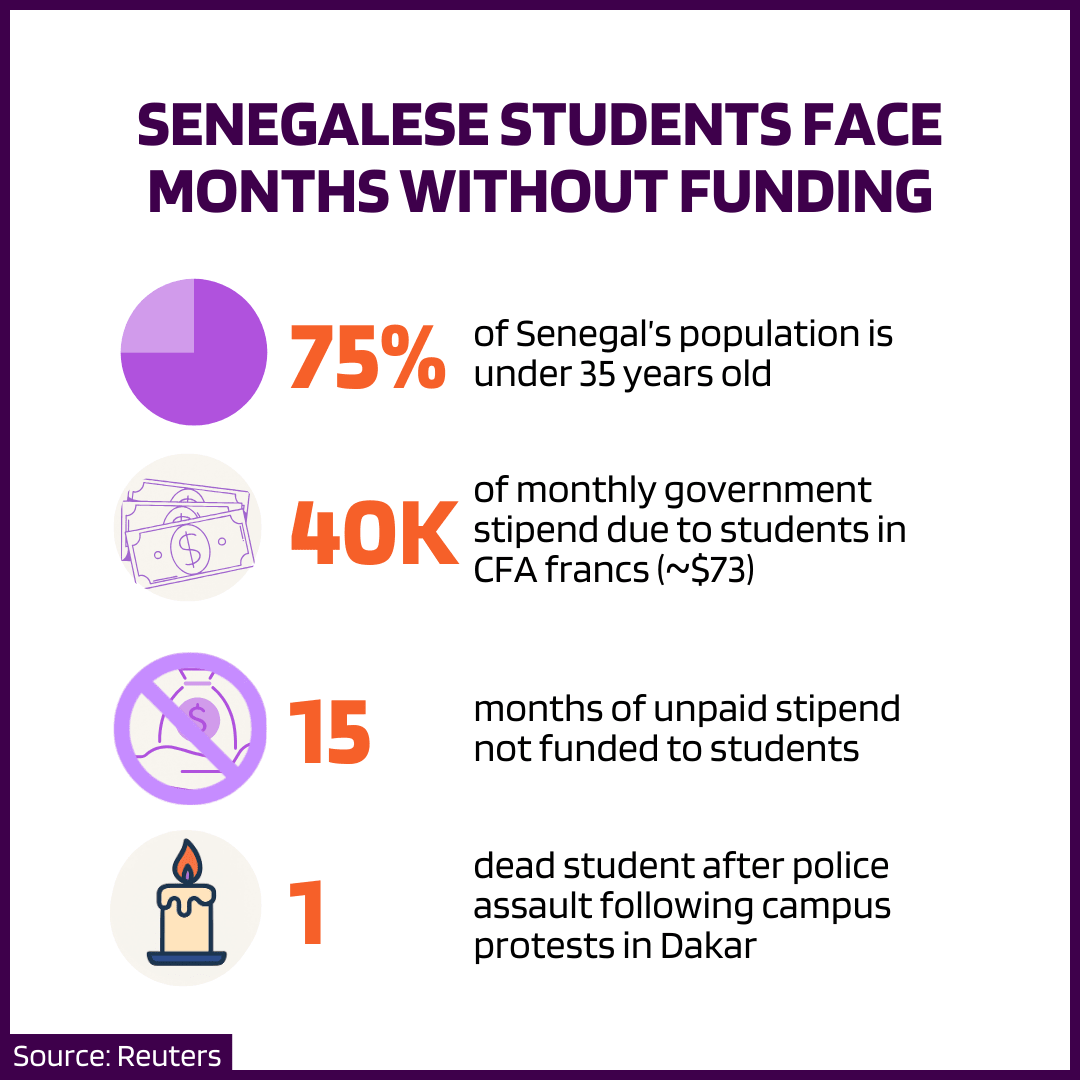
Death of a student. Following violent campus protests over unpaid scholarships at Senegal's top public university, Abdoulaye Ba, a second-year medical student, died in a hospital from severe head injuries. Cheilh Atab Sagne, president of the Student Association of the Faculty of Medicine, Pharmacy, and Dentistry, said Ba did not participate in the protests but was severely beaten by the police in his room. Several other students repeated the allegation.
Police brutality. Burned cars and broken barricades still littered the university grounds following clashes a day before between the police and students. A video posted on social media shows a fire started in a student housing building, as students try to flee, some jumping from windows.
Campus housing closed. Thousands of students left Cheikh Anta Diop University in the capital, Dakar, last week after campus housing was closed. The university calendar has been repeatedly disrupted for several years by prolonged closures following periods of unrest, sometimes lasting more than nine months and causing academic years to overlap. Students often go months without receiving monthly scholarships averaging about 40,000 CFA francs ($73). This sum is supposed to cover food, housing, and tuition in one of Africa's most expensive cities. |
|
Pragmatism Prevails in EU-Türkiye Ties By Beyza |
|
Strategic urgency is driving renewed engagement. The EU is seeking to reinvigorate relations with Türkiye, driven more by strategic urgency than by political reconciliation. Russia’s war against Ukraine, energy insecurity, and regional instability have reinforced Ankara’s role as a logistical and geopolitical hinge between Europe, the Black Sea, and the Middle East. Recent meetings between EU Commissioner for Enlargement Marta Kos and Turkish Foreign Minister Hakan Fidan signaled a willingness to rebuild functional cooperation despite persistent democratic and rule-of-law concerns.
Infrastructure binds the ties. Türkiye remains central to Europe’s efforts to diversify energy routes away from Russia. The Southern Gas Corridor and expanding LNG logistics rely on Turkish transit capacity, while electricity interconnection initiatives linking the Caucasus to Southeast Europe also depend on Ankara’s role. Brussels has discussed financing channels for green energy, transport corridors, and earthquake reconstruction, though renewed lending by the European Investment Bank remains exploratory rather than confirmed.
Trade realities expose structural imbalance. As the EU expands its global trade network, Ankara is pressing to update its own economic framework with the bloc. For Türkiye, modernizing the 1995 EU-Türkiye Customs Union is less a technical revision than an economic necessity. The current arrangement excludes services, agriculture, and public procurement, while obliging Türkiye to align with EU trade agreements without participating in their negotiation, creating a long-standing structural asymmetry. Any modernization mandate, however, requires approval from the European Council, where political objections continue to stall progress. Kos has reiterated that progress depends on “good neighbourly relations,” underscoring how geopolitical disputes remain intertwined with economic integration. Yet bilateral trade exceeds €200 billion annually, anchoring one of the EU’s most significant commercial partnerships.
A partnership short of commitment. Turkish officials continue to frame full EU membership as the long-term strategic goal, a position reiterated by Ankara’s ambassador to the EU. In Brussels, however, momentum toward reopening accession talks remains limited. For now, the relationship is evolving into a pragmatic arrangement in which cooperation on trade, connectivity, and security advances out of necessity, while deeper political alignment remains out of reach. |
|
Saudi Arabia Steps Up Diplomacy in East Africa to Contain the UAE By Michele |
|
From Yemen to Africa, the rift between Riyadh and Abu Dhabi continues to grow. After the most recent flare-up in Yemen, which resulted in a Saudi strategic victory and the worst deterioration of relations to date between the two Gulf countries, Riyadh is determined to thwart Emirati geopolitical ambitions. Tensions are high in East Africa, where the risk of a conflict between Ethiopia and Eritrea, or Somalia and its secessionist region of Somaliland, is ever-present. The UAE cultivated strategic relations in the region, especially with Somaliland and Ethiopia, and, along with support for the now-disbanded Yemeni STC and the RSF in Sudan, aimed to establish Emirati influence in the Red Sea and the Gulf of Aden.
A string of diplomatic moves by Saudi Arabia showcases its commitment to containing the former partner. In the wake of the crisis in Yemen, Riyadh wasted no time signing a military cooperation agreement with Somalia on February 9th, after the country cancelled all its standing agreements with the UAE. Concurrently, the Saudi foreign minister met with Ethiopia’s PM Abiy Ahmed Ali on February 11th, as Addis Abeba is Abu Dhabi’s main partner in the region and, although the multi-billion-dollar investments that drive Ethiopia-UAE relations make it unlikely that the former would “switch sides,” Riyadh is intent on exerting its own influence. Meanwhile, Saudi Arabia is balancing its influence in East Africa through backchannel talks with Eritrea, Ethiopia’s longtime rival, brokered by Egypt.
How far the rift between the two former parties will grow remains to be seen. Tensions are high, and an eventual conflict in East Africa may become a new outlet for the rivalry between Abu Dhabi and Riyadh, who already support opposing factions in Sudan, to escalate through proxies once more. Nonetheless, the benefits of alignment will likely outscale the costs of competition in both countries’ strategic calculations. With a plethora of ongoing crises in a volatile Middle East, from Gaza to Iran, Saudi-Emirati reconciliation will be back on the table when deemed convenient.
|
|
Syria and Lebanon Accuse Israel of War Crimes Over Glyphosate Spraying on Border Farms By Francesco |
|
Strategic urgency fuels border tensions. Syria and Lebanon have accused Israel of war crimes for deploying glyphosate herbicide on agricultural lands near their shared borders, framing the action as deliberate environmental destruction to create sterile buffer zones. Early February 2026 aerial operations targeted 8.5 square kilometers in southern Lebanon and farmland in Syria’s Quneitra region, with concentrations up to 50 times agricultural norms, threatening crops, livestock, water supplies, and long-term soil fertility.
Environmental damage dominates concerns. Glyphosate, classified as “probably carcinogenic” by WHO’s IARC in 2015 and banned in Lebanon and the EU, persists in soil for years, killing roots and beneficial microbes while risking groundwater contamination. Lebanese officials, including Agriculture Minister Nizar Hani, described the spraying (via low-flying civilian aircraft) as a “scorched earth” tactic echoing Gaza operations, aimed at denuding vegetation for security visibility along an 18-km strip.
Israel downplays the threat. The IDF notified UNIFIL of “non-toxic” aerial activity near the Blue Line on February 1, forcing peacekeepers to shelter and cancel patrols for nine hours, but offered no further comment on allegations. UNIFIL condemned the move as violating Resolution 1701, citing risks to civilians and agriculture in a ceasefire zone still scarred by 2024 fighting.
Diplomatic escalation looms. Beirut plans a UN Security Council complaint, calling the act a sovereignty breach and health hazard, while Euro-Mediterranean Human Rights Monitor labeled it a potential war crime for targeting civilian property without military necessity. Syria reported similar crop devastation from January 26-27 sprayings, amplifying regional outrage over transboundary harm. |
|
|
| |
|
|