| Hello ESTers, how have you been? Welcome back to InsideMENA, your go-to bimonthly dive into the latest developments across the Middle East and North Africa, touching upon the EU’s interests and beyond. From politics to culture, we’ve got you covered! We are once again ready to jump right InsideMENA! PS: If you are reading this on the website, don’t forget to subscribe to get InsideMENA straight to your inbox every fortnight! Edited by Clarice Agostini and Jesse Woche Note that the information, views and opinions set out in the newsletter are those of the authors and do not necessarily reflect the opinion or position of the editors, of the European Student ThinkTank, and of their affiliated entities or institutions.
|
|
Iran’s Economy: Microscopic Growth in 2025
By Mohammad
|
|
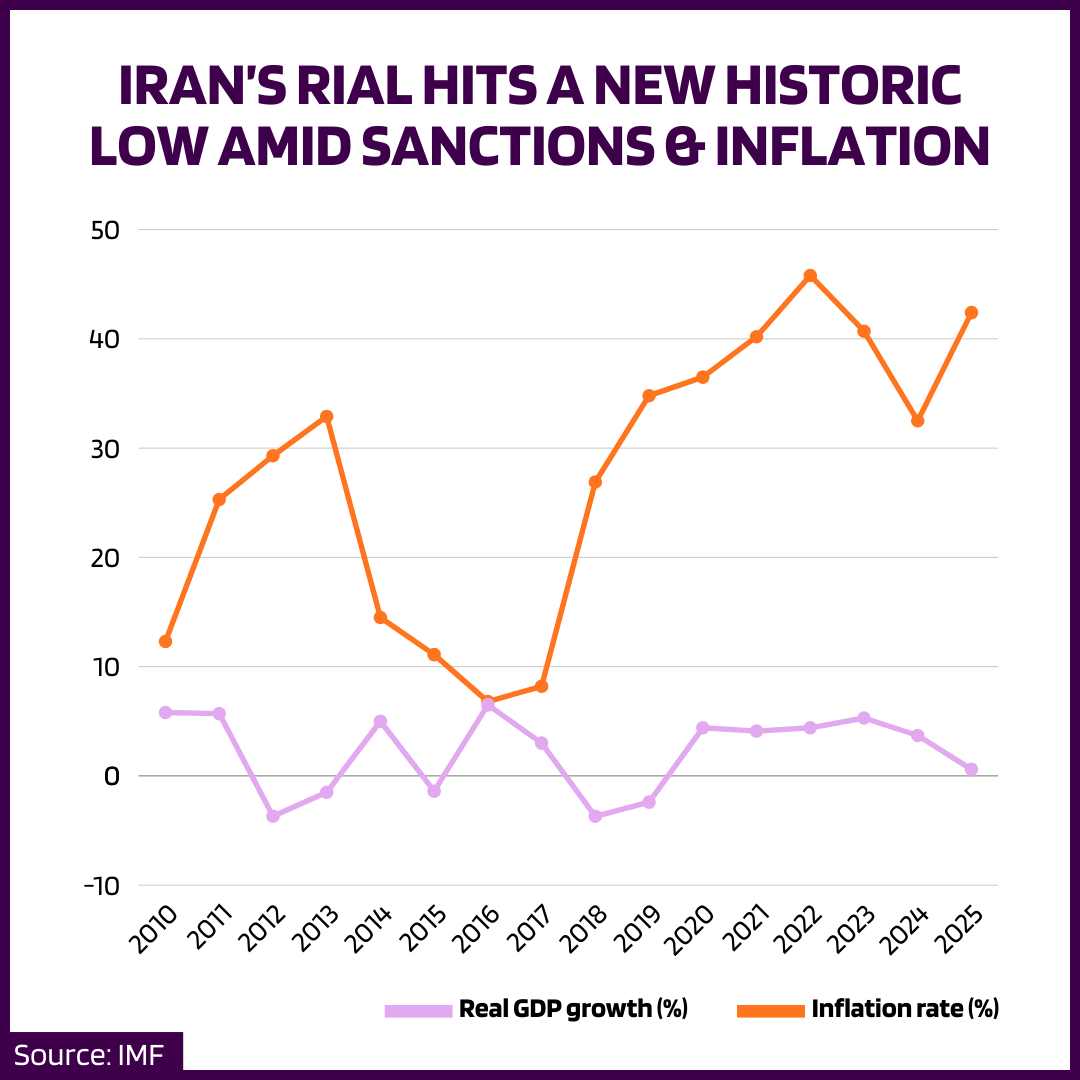
A Microscopic Growth. PressTV, an Iranian state-owned English news media organisation, proudly reports that Iran’s economy grew by 0.1% in the first half of the year. It is a number so small it almost feels symbolic. Still, state media frames it as proof that things are “moving,” even if no one agrees on which direction that might be. Reality Check, Courtesy of Everyone Else. Independent figures tell a less glamorous story: 40%+ inflation, a sinking rial, and IMF projections showing near-zero real growth. Add nationwide protests and the aftershocks of a costly June war with Israel, and the economic “miracle” starts looking more like wishful thinking. The Rial Hits the Floor (Again). With the U.S. dollar climbing to 1.26 million rials, even IRGC-affiliated outlets are openly criticizing the administration — a rare moment of unity across the political spectrum. Officials blame war damage and sanctions, while households face 66% higher food prices and a central bank that seems unable (or unwilling) to intervene to alter the economic decline. |
|
Pope Leo XIV's Official Visit to Lebanon
By Francesco
|
|
A Message of Hope Amid Crisis. From November 30 to December 2, the Pope made his first-ever visit to the Middle East, stopping in Lebanon after Turkey. This historic trip highlighted Lebanon’s long-standing tradition of Muslim-Christian coexistence, a deeply rooted social fabric now under severe strain. The Pope urged Lebanon’s political leaders to act as peacemakers during a time marked by economic collapse, institutional paralysis, and growing fears of renewed conflict involving Israel and Hezbollah. His presence was inspiring and hopeful in a country dealing with multiple crises. Massive Public Gatherings and Calls for Unity. The visit featured large open-air liturgies, including a striking mass held at Beirut’s waterfront attended by around 150,000 people. Despite the country’s hardships, crowds gathered enthusiastically to welcome the Pope, showing the deep spiritual connection many Lebanese maintain with the Catholic Church. Throughout his speeches, he called firmly for an end to hostilities and sectarian divides, emphasizing reconciliation and peace as essential for Lebanon’s survival. His message extended beyond Lebanon’s Christian community, speaking to all citizens yearning for unity and stability. High Costs Amid Economic Struggles. Hosting such a significant international visit came at a high price, with Lebanese authorities spending heavily on security, logistics, and events amid a devastating economic crisis. While many Lebanese welcomed the visit with genuine joy and hope, the government’s expenditure sparked debate, given the daily hardships faced by ordinary people. Nevertheless, the widespread enthusiasm for the Pope’s visit revealed the population’s yearning for spiritual comfort and international attention in a turbulent time. |
|
Erdoğan’s Warning Proves Ineffective as Tensions Rise in the Black Sea By Isabella
|
|
Explosions on the Black Sea. On November 28th, two Russian oil tankers cruising on the Black Sea suffered from explosions off the Turkish coast. Shortly after the tanker Kairos encountered an undetermined explosion, the second tanker, Virat, was reportedly struck by an unknown source. Virat was hit a second time the following day. Both vessels are a part of the internationally sanctioned Russian ‘shadow fleet’; their activities continue to earn the Kremlin multimillion dollars in revenue by circumventing sanctions. Initial statements by Turkish maritime authorities responding to the strikes were vague, and an air of mystery surrounded the attacks until Ukrainian officials confirmed their naval drones had targeted the tankers two days later. Erdoğan hands out warnings. Following the incident, Ministry of Foreign Affairs spokesperson Öncü Keçeli expressed concern about the attacks and their potential negative effects on economic activities in the Black Sea. In a statement on Monday, December 1st, Erdoğan declared any assault on commercial vessels unacceptable, deeming that ‘the attacks could in no way be justified.’ Erdoğan confirmed that both sides had been given the appropriate warning. Rising tensions and ineffective warnings. Tensions rose higher as MIDVOLGA-2, a third Russian tanker carrying sunflower oil to Georgia, was struck the day after Erdoğan’s statement. The attack is intensifying concerns about the spillover of the war into the Black Sea, which would be detrimental to the Turkish economy. |
|
Israel Accused of Fighting ‘ghosts’ in SyriaBy Hannah |
|
Unending attacks. This last week marked the first anniversary of the fall of Assad in Syria. In the preceding year, Israel launched over 600 attacks on Syria, averaging around two per day. Not new, but different. These attacks have primarily focused on the Southern Part of the country. While attacks have increased this past year, Israel's assault on Syria is nothing new: Israel has been occupying the Golan Heights since 1967. However, since the fall of Assad, Israel expanded the territory it occupies in Syria and established military outposts in nearby Syrian villages, violating the UN-brokered ceasefire. What purpose does this serve? These current attacks are justified under the guise of preventing weapons from falling into the hands of “extremists.” Yet only a few weeks ago, in one night, 13 people were killed in Israeli strikes, including children. As the Syrian President al-Sharaa noted, it appears that Israel is fighting “ghosts,” with very real consequences for Syrian civilians.
The colonial playbook. Human Rights Watch has suggested that Israel is applying unacceptable conditions on those in the South, including war crimes such as forced displacement. Their military has seized or destroyed homes, prevented Syrians from accessing their livelihood, and forcibly transferred Syrians into Israel. It is clear this violence must stop.
|
|
For any questions or suggestions, don’t hesitate to reach out at [email protected]! Learn more about EST on our Website. See you in two weeks, inshallah! The Observatory |
|
|
| |
|
|