Each episode tried to smuggle a small lesson inside the noise. Paco facing a storm (get the subtext?). Stella learning that not every story needs a villain. Someone discovering that asking for help is not the same as giving up.
The lessons were never announced with a freeze-frame and a moral. They arrived the way they sometimes do in real life - after hearing a song, or after an argument, maybe after someone almost fell through a hole in the floor.
The theme song itself was about procrastination. “I will do it when I get around to it” was less a slogan than our operating system.
The attic was always one repair away from being finished.
That unfinished quality was the point.
What I did not fully appreciate while we were making the show was how much of it was an argument with myself.
I was married. I was working. The attic was, on paper, a children’s program. In practice it was a place where a middle-aged comedy performer could still invent friends who expected nothing more complicated than the next scene.
The wife existed, but she was downstairs and off-camera, a gentle reminder that the attic had a door, portal back to reality.
The show never pretended the door was locked. It just kept finding reasons to stay on the other side of it a little longer.
That tension is what made the show feel true even when the plots were silly. Children understand the pull of a private room. Adults understand the guilt that arrives when the private room starts to feel more necessary than the rest of the house.
Taylor’s Attic lived in the narrow space between those two facts. The characters never asked me to choose. They simply kept talking until I sat down again.
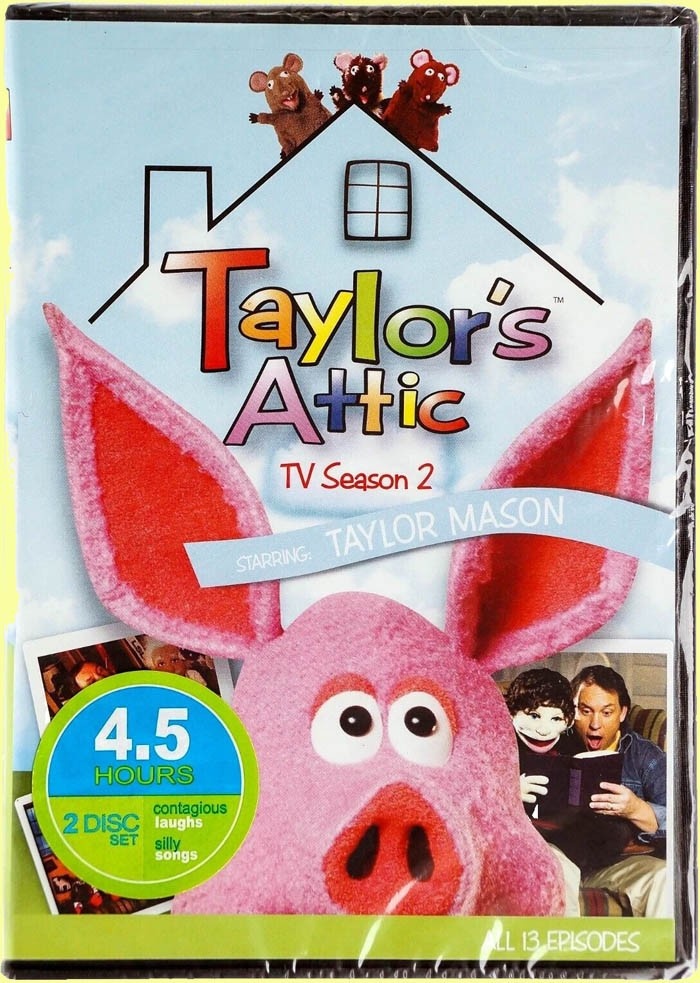
The series ended the way most local children’s shows eventually do. The DVDs still exist. A Christmas episode surfaces now and then. The puppets moved on to other stages, other rooms, lost to contractual obligations and ownership “rights.”
What remains is the memory of a place that was never fully organized and never fully abandoned. An attic is not supposed to be the main room of the house. It is supposed to hold the things you are not quite ready to throw away and the things you are not quite finished with. For a few seasons, that was enough premise to build a show around.
I still climb stairs. I still close doors behind me when the work requires concentration. The difference now is that the friends who used to wait in the attic have learned to travel.
They fit in cases. They appear in videos and on stages and, occasionally, in the middle of a set when a joke needs a second voice. The attic itself is gone, or at least the television version of it is.
What stayed is the habit of treating imagination as a room you can still enter, even after you promised to come downstairs.
TAYLOR’S ATTIC was a children’s TV program that lasted three seasons. The set was amazing, the puppeteers were better-than-the-game and the writer, sound designer, and director all deserved a better “lead” than myself. The show can still be found with a deep dive into cyberspace.
Thanks for reading!
Taylor
Please listen to the podcast I am part of: Stories Unlimited on Apple Podcast and Spotify Podcast. I am available for personal videos on CAMEO. I am still touring the planet in search of an audience. I am easy to find on social media.
Podcasts Spotify Cameo Irreversible (my book)