| | Hello ESTers!
Welcome back to InsideMENA, your bi-monthly snapshot of the key political, social, and cultural developments shaping the Middle East and North Africa, with an eye on Europe and the wider world.
This is our final edition before the summer break! We’d like to thank all our readers for following along with us, and we hope to have you back after the summer for more analysis, insights, and stories from across the MENA region.
Ready to dive in? Let’s go InsideMENA!
P.S. Reading this on our website? Subscribe to get InsideMENA straight to your inbox every fortnight.
Edited by Clarice Agostini and Jesse Woche Note that the information, views and opinions set out in the newsletter are those of the authors and do not necessarily reflect the opinion or position of the editors, of the European Student ThinkTank, and of their affiliated entities or institutions.
|
|
Gaza’s Medical Crisis: 16,500 Patients Blocked from Treatment Abroad By Hannah
|
|
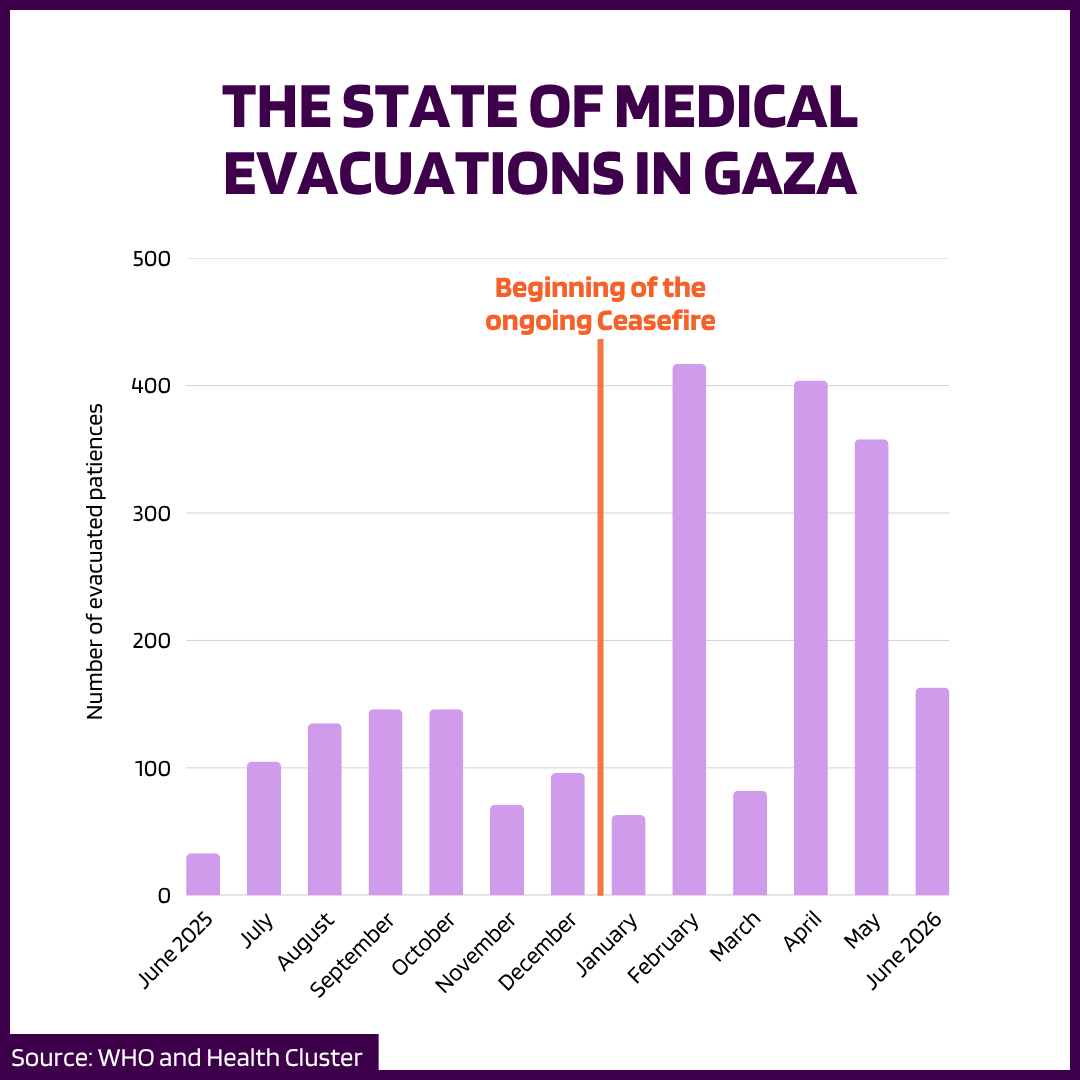
Medical emergency. The Health Ministry of Gaza has announced that 16,500 Palestinians are in need of medical treatment from abroad yet have been prevented from leaving by Israel, and that these delays directly lead to the deaths of patients.
Dire conditions. Despite the so-called ceasefire which has been in place since October 2025, Gaza remains besieged with near-daily attacks and continued restrictions on humanitarian aid and medical supplies. Israel has largely destroyed the Strip’s medical infrastructure and continues to obstruct reconstruction, leaving the healthcare system incapable of managing treatment for its patient load.
Unable to leave. The Rafah crossing, one of the few ways to leave the Gaza Strip, has repeatedly been closed by Israel, preventing critically ill patients from leaving. With 90% of the population of Gaza remaining displaced and in high levels of food insecurity, this medical crisis will only continue. |
|
From Confrontation to Cooperation? Benin Reaches Out to the AES By Jordi |
|
Benin reaches out to the AES. Just days after taking office, Benin's new President Romuald Wadagni chose Niger and Burkina Faso as his first foreign destinations, signalling a clear effort to ease tensions between Cotonou and the Alliance of Sahel States (AES). The visits follow years of strained relations linked to the 2023 coup in Niger and growing friction between ECOWAS and the Sahel juntas.
Cotonou's strategic importance. Beyond diplomacy, the rapprochement carries significant economic implications. The Port of Cotonou remains one of the main gateways for Sahelian economies, particularly Niger. Restoring trust could facilitate trade flows, reduce transport costs and improve access to coastal markets. For the AES, maintaining reliable access to regional ports is increasingly important as Member States seek to diversify economic partnerships and strengthen regional connectivity.
A signal beyond Benin. The initiative may offer an early indication of how relations between ECOWAS members and the AES could evolve. As security threats cross borders and economic interdependence remains strong, pragmatic cooperation may increasingly outweigh political divisions. For external partners such as the European Union, the development highlights the need to adapt to a changing regional landscape, balancing support for ECOWAS with practical engagement on security, trade and connectivity with AES states. |
|
The Revival of Hejaz Railway Signals Regional Connectivity Push By Beyza |
|
New steps in regional cooperation. Türkiye and Saudi Arabia have signed two memorandums of understanding to expand cooperation in railways and transport connectivity. The agreement places Riyadh among the latest actors supporting the revival of the historic Hejaz railway, a project that would link Türkiye to Syria, Jordan, and the Gulf. Turkish officials framed the move as a response to growing regional uncertainty, emphasizing the need to secure trade routes and maintain stable logistic chains.
A legendary project returns. Originally built during the Ottoman period, envisioned by Sultan Abulhamid II in 1900, the Hejaz railway once connected Damascus to Medina and was intended to extend further toward Istanbul. While it served economic, political and military-related purposes aiming to integrate distant regions of the empire, it was also intended to connect the Ottoman capital to the annual pilgrimage destination in Medina and Mecca, located in the Hejaz region. The network gradually collapsed after World War I and was later further damaged by decades of conflict, most recently the Syrian civil war.
Connectivity amid shifting geopolitics. Efforts to revive the railway reflect a broader push to develop overland trade corridors at a time of growing instability in maritime routes. Disruptions in the Gulf, alongside escalating tensions driven by Israel’s role as a regional aggressor, have reinforced the urgency of alternatives that bypass vulnerable chokepoints. In this context, connectivity has become a strategic response to instability. Emerging transport initiatives suggest a gradual shift toward regional frameworks aimed at reducing exposure to conflict dynamics imposed by dominant actors. Rather than relying on routes vulnerable to disruption, such as the Strait of Hormuz, countries are increasingly exploring land-based corridors that offer greater control and predictability. This reflects a wider effort to insulate trade and energy flows from geopolitical volatility. For Türkiye, this reinforces its position as a potential transit hub between Europe and the Gulf, aligning with a broader regional attempt to build more autonomous and resilient connectivity networks. |
|
|
| |
| |
|