͏‌ ͏‌ ͏‌ ͏‌ ͏‌ ͏‌ ͏‌ ͏‌ ͏‌ ͏‌ ͏‌ ͏‌ ͏‌ ͏‌ ͏‌ ͏‌ ͏‌ ͏‌ ͏‌ ͏‌ ͏‌ ͏‌ ͏‌ ͏‌ ͏‌ ͏‌ ͏‌ ͏‌ ͏‌ ͏‌ ͏‌ ͏‌ ͏‌ ͏‌ ͏‌ ͏‌ ͏‌ ͏‌ ͏‌ ͏‌ ͏‌ ͏‌ ͏‌ ͏‌ ͏‌ ͏‌ ͏‌ ͏‌ ͏‌ ͏‌ ͏‌ ͏‌ ͏‌ ͏‌ ͏‌ ͏‌ ͏‌ ͏‌ ͏‌ ͏‌ ͏‌ ͏‌ ͏‌ ͏‌ ͏‌ ͏‌ ͏‌ ͏‌ ͏‌ ͏‌ ͏‌ ͏‌ ͏‌ ͏‌ ͏‌ ͏‌ 
Is this email not displaying correctly? View it in your browser.
logo
Image description

In this issue, you'll find:

  • Celebrating Rocscience's 30th Anniversary as the Aquanty team joined colleagues in Toronto to mark this important milestone.

  • Upcoming webinars and events where we'll continue sharing the latest developments in hydrologic modelling and forecasting.

  • A new Hydraulic Mixing Cell (HMC) training webinar, created in response to the strong interest generated by our recent HMC webinars. Join Arghavan Tafvizi for a practical, hands-on session covering the complete Hydraulic Mixing Cell workflow— from model setup and configuration to post-processing, output interpretation and best practices for applying this powerful HydroGeoSphere capability

  • Two new HydroGeoSphere research highlights showcasing integrated hydrologic modelling applications in coastal marshes and the complex volcanic watershed of Mt. Fuji, Japan.

  • A new publication from members of the Canada1Water team exploring the impact of lakes on North American regional climate simulations.

  • The latest HydroGeoSphere software updates, research highlights, and upcoming training opportunities.

Image description
Image description

Aquanty Celebrated Rocscience's 30th Anniversary

This month, the Aquanty team joined our colleagues at Rocscience in Toronto to celebrate the company's 30th Anniversary.

Hosted in Toronto, the evening brought together staff from across the organization to recognize three decades of innovation, growth, and engineering excellence. It was a great opportunity to connect as one team and celebrate the people whose dedication continues to shape the future of our combined organizations.

Congratulations to everyone at Rocscience on this incredible milestone— we're excited to be part of the journey ahead!

Image description
Image description

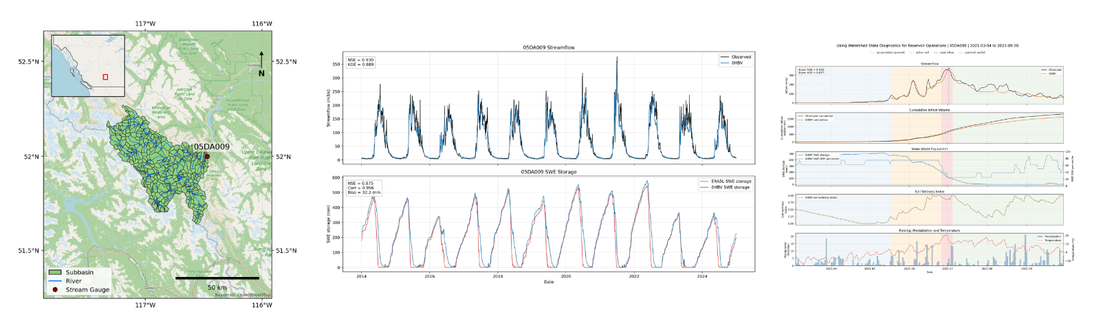
Delta Models for Reservoir Operations – NORTH SASKATCHEWAN RIVER AT WHIRLPOOL POINT (05DA009).

In this blog we present Aquanty's recent research into the use of hybrid "delta models", and demonstrate how next-generation watershed diagnostics can provide insight into reservoir inflow conditions, using the North Saskatchewan River at Whirlpool Point during the 2021 spring freshet as an example. Using a next-generation hybrid delta-model framework, Aquanty combines machine learning with process-informed hydrologic modelling to simulate reservoir inflows while providing insight into the watershed conditions driving them. By tracking snowpack, soil wetness, and routed flow alongside streamflow, the system provides a more transparent view of inflow timing, persistence, and potential operational risk. The case highlights how HydroSphereAI is evolving beyond streamflow forecasting— providing interpretable watershed intelligence to support reservoir planning, hydropower operations, and water resource management.

LEARN MORE
Image description
Image description

Webinar: An Integrated Surface Water and Groundwater Model Case Study to Assess the Effects of Groundwater Flood Events

Join us for an insightful presentation examining how integrated hydrologic modelling can improve our understanding of groundwater flooding and support more effective flood risk management in urban environments.

Image description
Image description

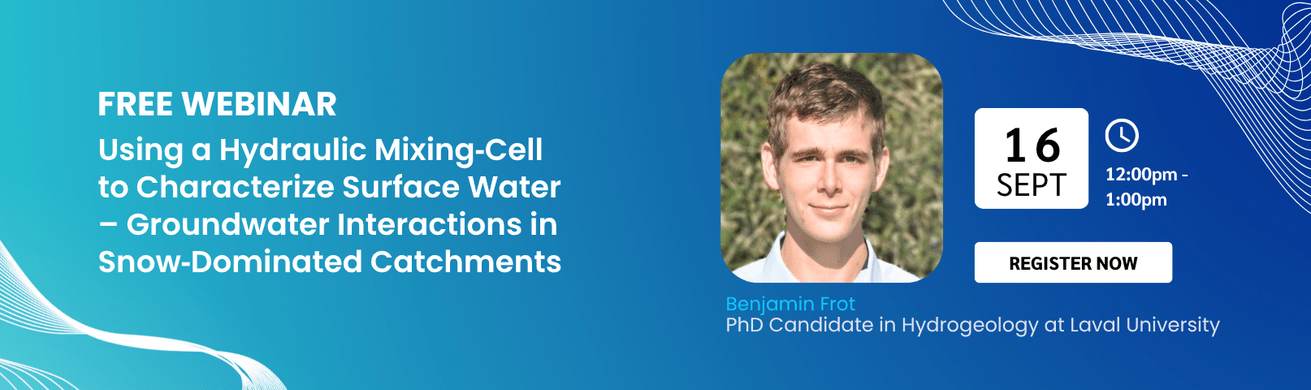
Webinar: Using a Hydraulic Mixing‑Cell to Characterize Surface Water – Groundwater Interactions in Snow‑Dominated Catchments

Join us for an engaging presentation which explores how the Hydraulic Mixing Cell technique in HydroGeoSphere can improve our understanding of groundwater contributions to streamflow, water age and climate change impacts in snow-dominated watersheds.

Image description
Image description

Webinar: Hydraulic Mixing Cell (HMC) Training Session in HydroGeoSphere

Join us for our upcoming webinar, Hydraulic Mixing Cell (HMC) Training Session in HydroGeoSphere, and build practical skills using one of HydroGeoSphere's most powerful tools for analyzing surface water–groundwater interactions. Led by Arghavan Tafvizi from Aquanty, this hands-on training session will guide participants through the complete Hydraulic Mixing Cell workflow—from model setup and configuration to post-processing, output interpretation, and best practices for applying HMC to integrated hydrologic models.

Image description
Image description
Image description

Effects of Creek Topology on Salinization of Coastal Marsh Due To Storm Surges

In this publication, researchers explored how creek network topology influences storm-surge-driven salinization in coastal marsh systems. Using HydroGeoSphere’s fully integrated surface–subsurface and variable-density modelling, the study showed that dense creek networks help dissipate surge energy and limit groundwater salinization, while sparse networks promote inland intrusion and slower recovery. The findings highlight how geomorphology controls both salinity impacts and recovery in coastal wetlands, emphasizing the importance of physics-based modelling with HGS for improving coastal resilience and management under increasing storm risk.

Read More

Image description

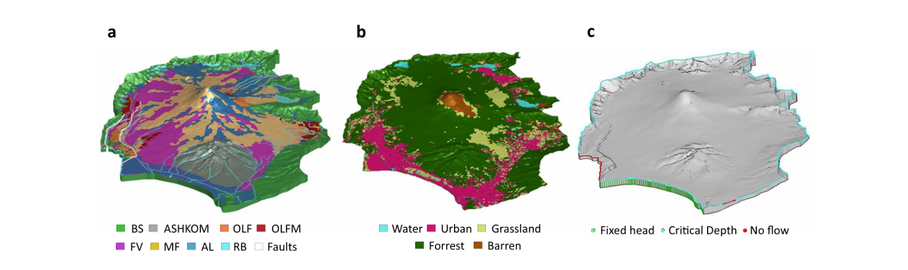
Modeling a geologically complex volcanic watershed for integrated water resources management in Mt. Fuji, Japan
This publication presents a three-dimensional geological and integrated hydrological modelling dataset developed for the Mt. Fuji volcanic watershed in Japan. This study leverages HydroGeoSphere (HGS) to simulate coupled surface–subsurface flow and transport processes in a geologically complex volcanic catchment, addressing long-standing challenges in representing groundwater flow pathways and hydrologic interactions in structurally heterogeneous mountain environments. The resulting dataset provides a physically consistent modelling framework to support interdisciplinary water resources research and scenario-based hydrologic simulations.

Read More

Image description

New Publication: The Impact of Lakes in North American Regional Climate Simulation

We're pleased to share a new publication by Mani Naderi exploring the influence of lakes on North American regional climate simulations. Using the Weather Research and Forecasting (WRF) model coupled with three different lake models, the study evaluates how lakes influence regional temperature, precipitation, ice cover, and climate trends. The findings demonstrate that lakes play an important role in shaping regional climate, improving our understanding of climate processes and supporting more accurate environmental modelling.

LEARN MORE

Canada1Water Summer 2026 Newsletter Release

Incase you missed it, last month the Canada1Water newsletter had been released. In this issue, the C1W team shares recent progress on model development, new data delivery initiatives, research publications and practical applications of the Canada1Water framework across Canada and internationally.

Click below to read the full newsletter and stay up to date on the latest Canada1Water developments.

LEARN MORE
Image description

Intro to HydroGeoSphere

Next session: August 5, 2026
Every month Aquanty's technical sales lead Brayden McNeill delivers a FREE 3-hour HGS crash course. This quick session will introduce topics such as the basic HGS workflow, the essential components of a *.grok file and visualizing model results.

REGISTER FOR TRAINING SESSION

HGS Software Release

Find our monthly HGS software update on our HGS Downloads page. A quick reminder that if you are updating to the Jan/Feb/Mar 2026 release there are some important installations steps to follow (one time only), find the details in the Release Notes.

The July 2026 software update is now available. This release enhances surface water boundary conditions, transport simulations, raster handling, and solver robustness, while introducing new tools for surface flow control, sorption modeling, and CSV output.

Key updates include:

• New csv flux output nodes and csv head output nodes commands for simplified data export and post-processing

• New langmuir isotherm and zoned langmuir isotherm commands to support Langmuir sorption modeling

• New impermeable surface command for time-controlled surface–subsurface flow interactions

hsplot has been officially removed from the HGS installation— hgs2vtu is now the standard post-processing tool

• Improved solver robustness with automatic timestep recovery from preconditioner failures

• Multiple fixes for surface boundary conditions, transport calculations, and surface domain element selection to improve simulation accuracy


As always, we are committed to the continued improvement to the user experience. Do you have suggestions for new commands or improvements to the user experience? Send your ideas to [email protected]!

Read the release notes to see recent improvements to HydroGeoSphere.
Copyright © 2025 Aquanty Inc., All rights reserved.
Aquanty Inc., 600 Weber St.N., Unit B, Waterloo, ON N2V1K4, Canada, (519)-279-1080 [email protected]

Want to change how you receive these emails?
You can update your preferences or unsubscribe from this list.

If you would like to unsubscribe, please click here.