| | Hello ESTers!
Welcome back to InsideMENA, your bi-monthly snapshot of the key political, social, and cultural developments shaping the Middle East and North Africa, with an eye on Europe and the wider world.
As always, we’re bringing you concise analysis and fresh perspectives from across the region, along with InsideCulture, our dedicated space for music, film, writing, and digital voices that spotlight the stories and creativity shaping everyday life across the MENA region.
Ready to dive in? Let’s go InsideMENA!
P.S. Reading this on our website? Subscribe to get InsideMENA straight to your inbox every fortnight.
Edited by Clarice Agostini and Jesse Woche Note that the information, views and opinions set out in the newsletter are those of the authors and do not necessarily reflect the opinion or position of the editors, of the European Student ThinkTank, and of their affiliated entities or institutions.
|
|
No Route to Safety: Deadly Migration Journeys and Hardening of the EU Migration Agenda By Alicia
|
|
Mediterranean crossings remain deadly. In the first two months of 2026 alone, more than 600 people were recorded dead or missing in the Mediterranean while attempting to reach Europe. This has been described as an unprecedented figure, pointing to a concerning trend for the year. In early February, 53 people lost their lives when a boat capsized off the Libyan coast.
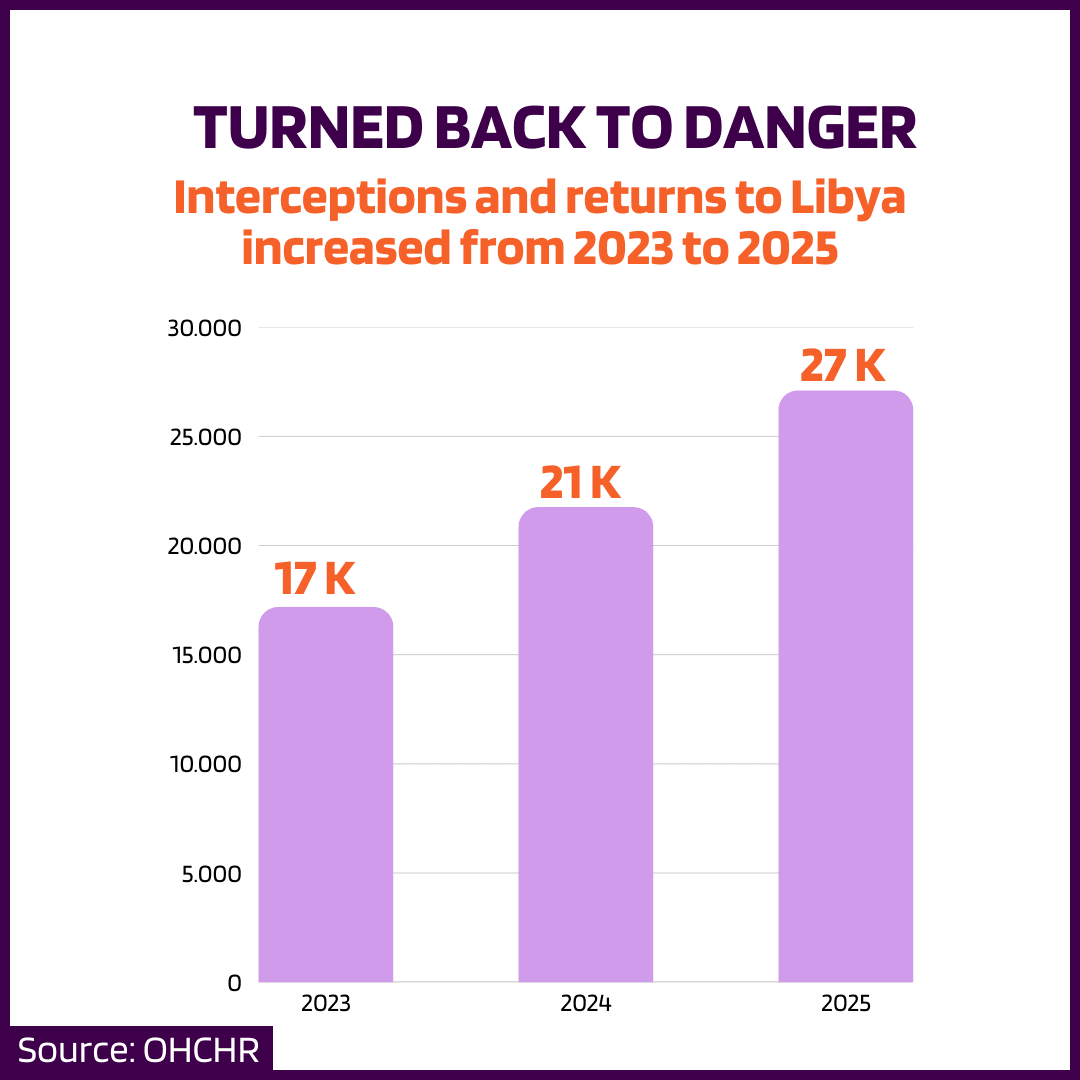
Libya as a dangerous transit hub. Despite its well-documented risks, Libya has become a major transit country for migrants and refugees. While waiting to cross to Europe, migrants often fall into the hands of militias and armed groups that have entrenched themselves in the country since the civil war. According to a recent UN Human Rights Office report, migrants in Libya face systematic abuses including arbitrary detention, killings, torture, sexual violence, and trafficking. These abuses have become part of a profit-driven system in which human mobility and detention have been turned into a source of revenue, and have blurred the line between state authority and criminal enterprise.
EU talks on deportations continue. European actors continue to discuss tougher deportation policies, broader police powers, return hubs outside Europe, and migration cooperation with third countries. For instance, the EU is funding a controversial new coast guard centre in Benghazi in coordination with Khalifa Haftar, while also moving closer to a migration pact with Senegal, amid concerns over a possible refugee exodus from the Middle East. Together, these new laws are shaping a harsher EU deportation regime. Yet as long as safe and legal pathways remain out of reach and root causes of migration are not addressed, it can be expected that people will continue to undertake these dangerous journeys. |
|
Türkiye’s F-16 Deployment Signals Rising Military Posture Around Cyprus By Beyza |
|
War expands to the Eastern Mediterranean. Following the regional escalation triggered by U.S. and Israeli strikes on Iran in late February, tensions have extended to the Eastern Mediterranean. Iran’s retaliatory attacks reportedly targeted sites on Cyprus, where the United Kingdom maintains two military bases. According to regional reports, at least three drones and two ballistic missiles have been launched toward the British RAF base at Akrotiri, with several of the aerial threats intercepted before reaching the island. These incidents have heightened security concerns across Cyprus, which occupies a unique position in Europe’s security architecture as one of four EU member states outside NATO.
Ankara signals protection of Northern Cyprus. Against this backdrop, Türkiye’s Ministry of National Defense confirmed that new military planning is underway to strengthen the security of the self-declared Turkish Republic of Northern Cyprus (TRNC). Officials indicated that deploying Turkish Air Force F-16 fighter jets to the island was under consideration, later announcing their arrival as a mission carried out “for our brothers.” Ankara frames the move as a precautionary measure aimed at protecting the Turkish Cypriot population and administration in northern Cyprus, which lacks its own combat aircraft or advanced defense systems. The TRNC is recognized only by Türkiye.
A crowded military theatre. Türkiye’s move follows a broader buildup by regional and European actors. Greece has dispatched fighter jets and naval vessels, while France, Italy, Spain, Germany, and the United Kingdom have also deployed ships, aircraft, or air-defense assets to the area, turning the waters around Cyprus into an increasingly dense military theatre. For European policymakers, the episode serves as a reminder that the island’s unresolved status continues to intersect with wider regional security dynamics. |
|
The Impact of the U.S.-Israeli Air Attacks on Civilians and Infrastructure By Clara-Joy |
|
Targeting of civilian infrastructure and casualties. As the air attacks on Iran perpetrated jointly by the United States and Israel have increased, so have the numbers of civilians affected, wounded, and killed. According to Iranian Deputy Health Minister Ali Jafarian, hundreds of civilians have been killed since the conflict began. Aside from murdering civilians, the U.S.-Israel coalition has also targeted numerous civilian infrastructures and equipment, such as healthcare facilities, health centres, clinics, emergency service locations, and ambulances.
Health and environmental consequences of attacks on fuel facilities. Israeli air attacks on a number of fuel storage facilities, such as oil warehouses, refineries, and an oil depot in Tehran, have resulted in the spread of thick and toxic smoke, filling the streets and sky over the city. Health Minister Jafarian has warned that this situation could lead to acute respiratory issues as well as long-term environmental effects. Immediately after the attacks, Iran’s environmental agency and the Iranian Red Crescent Society strongly advised residents to stay in closed and protected spaces such as their homes. They have also warned that the accumulation of toxic chemicals in the air could lead to acid rain and soil pollution.
International Humanitarian Law implications. Under International Humanitarian Law, the deliberate attack on civilian infrastructure and civilian objects, such as healthcare facilities and oil storage facilities, constitutes a grave legal violation which has had and will continue to have serious and lasting effects on the Iranian population and the country’s environment. |
|
Israeli Strikes Push Lebanon Deeper into Regional Escalation By Francesco |
|
War tightens around Beirut. Israeli airstrikes across Lebanon have killed at least 11 people in recent days, hitting areas around Beirut as well as the eastern city of Baalbek and several locations in the south. Targets have included a hotel on the edge of the capital and a multi-storey residential building in Baalbek, where civilian casualties and collapsed structures underlined how densely populated neighbourhoods far from the southern front are now exposed to the conflict. Israeli officials frame the escalation as a campaign against Hezbollah infrastructure and Iranian-linked actors, while Hezbollah presents its own fire as retaliation for the “criminal” Israeli aggression.
A regional lens in Brussels. In Europe, the latest Lebanese deaths have largely been addressed within a broader regional approach rather than as a standalone episode. EU officials have condemned Iran’s “inexcusable” missile and drone attacks and called on all parties, including Israel and the United States, to avoid further escalation and return to diplomacy. Public messaging from Brussels so far has focused on de‑escalation and regional stability, with references to Israeli strikes in Lebanon folded into wider statements on the ongoing confrontation. |
|
|
| |
| |
|