| Hello ESTers!
Welcome back to InsideMENA, your bi-monthly snapshot of the key political, social, and cultural developments shaping the Middle East and North Africa, with an eye on Europe and the wider world.
As always, we’re bringing you concise analysis and fresh perspectives from across the region, along with InsideCulture, our dedicated space for music, film, writing, and digital voices that spotlight the stories and creativity shaping everyday life across the MENA region.
Ready to dive in? Let’s go InsideMENA!
P.S. Reading this on our website? Subscribe to get InsideMENA straight to your inbox every fortnight.
Edited by Clarice Agostini and Jesse Woche Note that the information, views and opinions set out in the newsletter are those of the authors and do not necessarily reflect the opinion or position of the editors, of the European Student ThinkTank, and of their affiliated-entities or institutions.
|
|
EU’s Endorsement of Morocco’s Autonomy Plan: Pragmatism Over Principle
By Romane
|
|
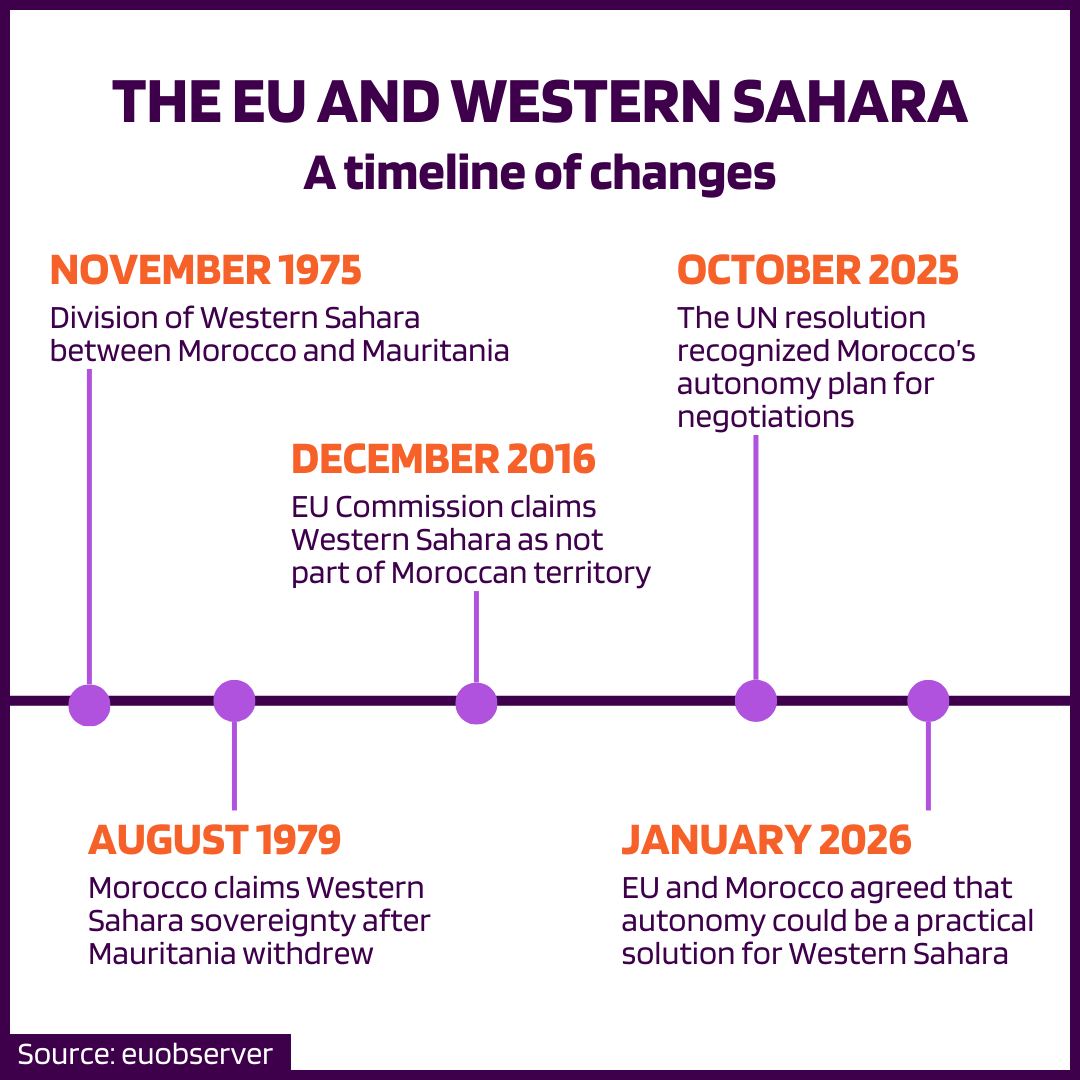
Policy shift. The European Union’s recent endorsement of Morocco’s autonomy plan for Western Sahara marks a significant change in its approach to a long-standing territorial dispute, reflecting a broader recalibration of EU–Morocco relations driven by security and geopolitical priorities rather than legal or normative coherence. While Brussels continues to rhetorically support a UN-led process and the principle of self-determination, its growing alignment with Rabat underscores the limits of the EU’s normative power when confronted with migration pressures and regional instability.
Negotiation context. This shift is rooted in the asymmetric foundations of the partnership. The EU’s leverage derives primarily from its economic weight and regulatory influence, whereas Morocco’s bargaining power stems from its strategic geographic position and its pivotal role in migration control, counterterrorism, and Sahelian stability. As a result, migration and security cooperation increasingly function as instruments of political leverage.
Incoherences remain. Spain’s policy reversal exemplifies this dynamic. Following a migration crisis in 2021, Madrid abandoned decades of neutrality by supporting Morocco’s autonomy proposal in 2022, illustrating how Rabat can transform operational cooperation into diplomatic concessions. Yet legal contradictions remain unresolved: the European Court of Justice has reaffirmed that Western Sahara is separate from Morocco and that EU–Morocco agreements must demonstrate tangible benefits and consent from the Sahrawi population. By edging closer to Rabat, the EU risks entrenching a pragmatic but legally fragile status quo that undermines its credibility as a normative actor. |
|
The U.S. Expands Intelligence Sharing in Sahel Amid Rising Islamist Threats By Jordi |
|
Washington scales up intelligence cooperation in West Africa. The United States has expanded military intelligence sharing with Nigeria and opened communication lines with Burkina Faso, Mali, and Niger as part of its counter-terrorism engagement in the Sahel and Lake Chad Basin. The move reflects growing concern over the operational reach of jihadist groups affiliated with the Islamic State and Al-Qaeda, and seeks to enhance surveillance, reconnaissance, and battlefield awareness for partner armed forces.
Security support amid political instability. This shift comes as the Sahel’s security landscape remains volatile: jihadist attacks have surged, including recent assaults on infrastructure in Niger, forcing regional militaries to balance counter-terror operations with fragile political conditions and strained regional alliances.
The EU pursues governance and development alongside security. By contrast, the European Union has emphasised non-kinetic support, which includes political dialogue, development cooperation, humanitarian aid, and institutional reform in the Sahel, framing instability as a governance and socio-economic challenge rather than a purely military problem. This approach stands in contrast with the U.S.’s security-focused assistance. |
|
Rafah Partially Reopens as Humanitarian Needs in Gaza Remain Unmet By Alicia |
|
Partial reopening of the Rafah border. The Rafah crossing with Egypt has long been the only direct exit from Gaza to the outside world and a vital entry point for aid into Gaza. Largely closed and under Israeli military control since May 2024, it has partially reopened this week. Israeli authorities state that the crossing will allow Gaza residents to cross on foot only, in both directions, and under strict security checks. In coordination with Egypt, the European Union will supervise the crossing under the EUBAM Rafah mandate.
Thousands await medical evacuation amid limited crossing. Many of those expected to leave for Egypt are in urgent need of medical care abroad. While more than 18,500 patients reportedly require treatment unavailable in Gaza, only around 50 patients per day will be allowed to cross into Egypt. Meanwhile, Egyptian authorities have affirmed the readiness of their healthcare facilities, from hospitals to equipped ambulances, to ensure smooth support and organization.
Aid still restricted. The reopening of the border was a key condition of the first phase of “Trump’s Gaza plan,” which also promised full humanitarian assistance. However, Israel continues to restrict aid entry and has recently banned 37 humanitarian aid organizations from operating in Gaza. This move has drawn international condemnation, as it is expected to further worsen conditions on the ground. |
|
A New Agreement for Kurds in Syria By Hannah |
|
An end to conflict. The Syrian government and Kurdish forces have negotiated a permanent ceasefire after government forces swept through the North East of the country, gaining control of territory held by the Syrian Democratic Forces (SDF) for nearly fourteen years, seeking to unite Syria into one territory.
An integrated Syria. Kurdish forces will be integrated into the state, while keeping independence through SDF brigades. Equally, civil institutions of the Kurdish authorities will be absorbed into the Syrian state. This is a significant reduction in the autonomy of the region, given that for fourteen years, this North-Eastern part of Syria, Rojava, has been governed by the Kurds with their own governing institutions and armed forces.
Just inclusion. One of the many concerns for the Kurdish people is whether their culture and language will be respected and protected, given that over the entire Assad family rule, the Kurdish people were subjugated and oppressed. The deal includes civil and education rights for Kurdish people, recognises Kurdish as one of the country’s national languages, and restores citizenship to all Kurdish Syrians. Only time will tell whether this agreement leads to just and equal inclusion of Kurds into the Syrian state.
|
|
Rising Tensions Between the U.S. and Iran: A Risk to Regional Stability By Clara-Joy |
|
Rising US-Iran tensions. Tensions between the U.S. and Iran have once again caught international attention following Washington’s recent threats to take military action against Tehran. Reports highlighting the U.S.’s strategic positioning of naval and air assets across the Gulf indicate that an attack on Iran could happen at any moment. This stance is tied to Iran’s continued avoidance to reach a deal on its nuclear programme development and its violent suppression of domestic protests.
Tehran’s response. Iran’s Supreme Leader, Ayatollah Ali Khamenei, has issued severe warnings that any U.S. strike on Iranian soil will result in nothing less than a regional war. While rhetoric on both sides has intensified, the consequences of military action remain uncertain.
Potential outcomes. An optimistic but unlikely scenario involves precise and limited strikes on Iran’s military and nuclear capabilities, potentially triggering a democratic transition, though the chaotic aftermath of Western interventions in Iraq and Libya raises doubts. More plausible outcomes include the Iranian regime’s survival but with policy moderation, or its collapse in favour of an IRGC-dominated military government.
Retaliation and regional risks. Iran could attack U.S. bases and regional allies, disrupting global energy markets through sea mines in the Strait of Hormuz – a critical maritime corridor – or engage in asymmetric naval attacks on U.S. warships. However, regime collapse remains the most destabilising risk, potentially triggering a regional humanitarian crisis in a country with over 90 million people.
|
|
|
| |
|
|