͏‌ ͏‌ ͏‌ ͏‌ ͏‌ ͏‌ ͏‌ ͏‌ ͏‌ ͏‌ ͏‌ ͏‌ ͏‌ ͏‌ ͏‌ ͏‌ ͏‌ ͏‌ ͏‌ ͏‌ ͏‌ ͏‌ ͏‌ ͏‌ ͏‌ ͏‌ ͏‌ ͏‌ ͏‌ ͏‌ ͏‌ ͏‌ ͏‌ ͏‌ ͏‌ ͏‌ ͏‌ ͏‌ ͏‌ ͏‌ ͏‌ ͏‌ ͏‌ ͏‌ ͏‌ ͏‌ ͏‌ ͏‌ ͏‌ ͏‌ ͏‌ ͏‌ ͏‌ ͏‌ ͏‌ ͏‌ ͏‌ ͏‌ ͏‌ ͏‌ ͏‌ ͏‌ ͏‌ ͏‌ ͏‌ ͏‌ ͏‌ ͏‌ ͏‌ ͏‌ ͏‌ ͏‌ ͏‌ ͏‌ ͏‌ ͏‌ 
Is this email not displaying correctly? View it in your browser.
logo
Image description
Image description

As we step into 2026, I want to take a moment to reflect on what was a landmark year for Aquanty. One of the most exciting developments came this December with the announcement that Rocscience has acquired Aquanty, opening a powerful new chapter in our company’s story.

This partnership brings together two industry leaders— fusing Aquanty’s hydrologic and hydroclimate modeling capabilities with Rocscience’s geotechnical engineering ecosystem. The result? Smarter, more integrated solutions for water and ground modeling across sectors like mining, infrastructure, and environmental planning. It’s a transformative moment, and one that greatly expands our reach and ability to drive impact.


We were also thrilled to receive national recognition for innovation in the water sector. HydroSphereAI, our machine-learning-based streamflow forecasting system, won the 2025 Water Canada New Tech Award. Congratulations to our development team for their hard work in bringing this ML-powered solution to life. We also extend our congratulations to our partners at Manitoba Forage and Grassland Association, who won the Early Adopter/Innovation Partnership Award for our long-standing collaboration to bring real-time hydrologic forecasting system to the Assiniboine River Basin.


Looking back, 2025 has been full of opportunities to engage, present, and learn across Canada. We attended and presented at over half a dozen national conferences and delivered four webinars on topics ranging from agricultural water management to HGS post-processing. I want to thank our team for their energy and commitment throughout the year, and our collaborators for continuing to trust Aquanty with their most complex water challenges.


From all of us at Aquanty— thank you for being part of our journey and for your continued support as we continue into 2026!

Image description
Image description

Rocscience Completes Acquisition of Aquanty to Strengthen Leadership in Water Resources and Hydroclimate Analytics
We ended 2025 with transformative news: Rocscience has officially acquired Aquanty. This exciting partnership brings together Aquanty’s world-class hydrologic and hydroclimate modeling expertise with Rocscience’s powerful geotechnical engineering ecosystem. The result? Smarter, more integrated modeling solutions across sectors like mining, infrastructure, and environmental planning.


“The association with Rocscience marks a new chapter for Aquanty, allowing us to leverage a wider platform and customer reach. Together, we will accelerate the innovation of advanced, hydrologic modeling tools that help clients better understand and adapt to complex water cycle dynamics and climate impacts worldwide.” Steve Berg, President, Aquanty Inc.


This merger strengthens our global reach and reinforces our mission to build tools that help engineers and practitioners make faster, more confident decisions in a changing climate.


Learn more.

Image description
Image description

Webinar Recap: HydroGeoSphere Development 2025: The Year In Review

Join us as we look back at the major developments, enhancements, and structural changes introduced to HydroGeoSphere over the past year. During this webinar we review the many new commands/features introduced in 2025, key changes to binary file formats resulting in memory and runtime improvements, and highlight key structural changes to the HydroGeoSphere ecosystem.

Image description
Image description

Webinar Recap: Introducing hgs2vtu for HGS Model Post-Processing

Discover hgs2vtu.exe, HydroGeoSphere’s new post-processing utility. This webinar introduces its streamlined workflow, modern export formats, and key improvements over hsplot.exe

Image description
Image description
Image description

Characterizing Spatial Heterogeneity of Hydraulic Conductivity Using Borehole NMR in a Complex Groundwater Flow System

This research highlight investigates how borehole nuclear magnetic resonance (NMR) logging can be used to characterize subsurface heterogeneity and improve the representation of hydraulic conductivity in groundwater flow models. HydroGeoSphere modelling was used to evaluate the predictive performance of NMR-derived hydraulic conductivity (K) models and assess how different spatial interpolation and upscaling approaches influence flow and drawdown predictions in a highly heterogeneous aquifer system.


Read More.

Image description

External and internal drivers behind the formation, vegetation succession, and carbon balance of a subarctic fen margin

In this research publication, researchers investigated the formation, vegetation succession, and carbon balance of peatland margins in Finnish Lapland. This study used HydroGeoSphere (HGS) alongside paleoecological records and remote sensing to address long-standing challenges in understanding how new peatland areas initiate, expand, and influence climate through carbon cycling.


Read More.

Image description

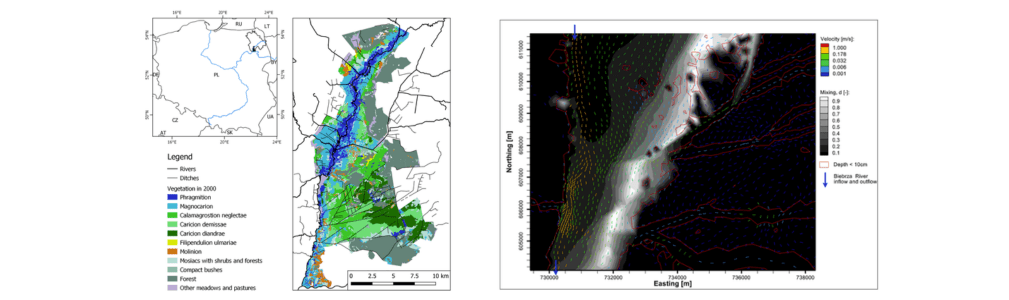
Using water sources extent during inundation as a reliable predictor for vegetation zonation in a natural wetland floodplain

We’re pleased to highlight this publication, co-authored by Tomasz Berezowski and Martin Wassen, which investigates how the extent of water sources during inundation can be used as reliable predictors of vegetation zonation in wetland floodplains. This study leverages HydroGeoSphere (HGS) together with the Hydraulic Mixing-Cell (HMC) method to address long-standing challenges in modelling vegetation dynamics by explicitly accounting for the spatial distribution of different water sources during floods.


Read More.

Groundwater flow and age in topography-driven groundwater flow systems with geological barriers

The research examines how groundwater age and flow systems are influenced by topography and geological barriers, using numerical simulations to clarify the interaction between surface-driven flow and subsurface heterogeneity. Traditional models of topography-driven flow often assume homogeneous geologic conditions, which can obscure the role of stratigraphic variations in shaping groundwater movement and age distribution. This study offers a detailed exploration of how structural barriers— such as low-permeability formations— interrupt or redirect groundwater pathways and affect the spatial and temporal distribution of groundwater age.


Read More.

Natural and anthropogenic drivers of the water table dynamics in a riparian fen peatland

This publication, co-authored by Adrien Renaud, Claude Mügler, Véronique Durand, and Marc Pessel, examines the natural and anthropogenic drivers of water table dynamics in a riparian fen peatland along the Essonne River in France. This study leverages HydroGeoSphere (HGS) to couple surface and subsurface hydrology, providing new insights into how precipitation seasonality, vegetation activity, and river regulation influence peatland water levels.


Read More.

Image description

Intro to HydroGeoSphere

Next session: February 11, 2026
Every month Aquanty's technical sales lead Brayden McNeill delivers a FREE half-day training session. Our Introduction to HydroGeoSphere training sessions cover essential topics such as the basic HGS workflow, the essential components of a *.grok file and visualizing model results.

REGISTER FOR TRAINING SESSION

HGS Software Release

Find our monthly HGS software update on our 'HGS Downloads' page. The January 2026 monthly software update is now available and this release introduces a major overhaul to the HGS installation system on both Windows and Linux, making upgrades more robust and easier to manage going forward. Please note that when updating to this latest version some special steps will need to be taken during the software update! 


***Users must uninstall the old version, remove the old PROJ folder, and reinstall to the new directory structure before continuing with future updates. These special steps will only need to be made once when installing a newer software version released January 2026 or later. Subsequent software updates will only require the user to download an installation file and follow the usual prompts in the installation wizard.***


These one-time steps ensure a clean transition to the new, more reliable installation system.


Read more (and access the installer) via the blog.


As always, we are committed to the continued improvement to the user experience. Do you have suggestions for new commands or improvements to the user experience? Send your ideas to [email protected]!

Read the release notes to see recent improvements to HydroGeoSphere.

Copyright © 2025 Aquanty Inc., All rights reserved.
Aquanty Inc., 600 Weber St.N., Unit B, Waterloo, ON N2V1K4, Canada, (519)-279-1080 [email protected]

Want to change how you receive these emails?
You can update your preferences or unsubscribe from this list.

If you would like to unsubscribe, please click here.