͏‌ ͏‌ ͏‌ ͏‌ ͏‌ ͏‌ ͏‌ ͏‌ ͏‌ ͏‌ ͏‌ ͏‌ ͏‌ ͏‌ ͏‌ ͏‌ ͏‌ ͏‌ ͏‌ ͏‌ ͏‌ ͏‌ ͏‌ ͏‌ ͏‌ ͏‌ ͏‌ ͏‌ ͏‌ ͏‌ ͏‌ ͏‌ ͏‌ ͏‌ ͏‌ ͏‌ ͏‌ ͏‌ ͏‌ ͏‌ ͏‌ ͏‌ ͏‌ ͏‌ ͏‌ ͏‌ ͏‌ ͏‌ ͏‌ ͏‌ ͏‌ ͏‌ ͏‌ ͏‌ ͏‌ ͏‌ ͏‌ ͏‌ ͏‌ ͏‌ ͏‌ ͏‌ ͏‌ ͏‌ ͏‌ ͏‌ ͏‌ ͏‌ ͏‌ ͏‌ ͏‌ ͏‌ ͏‌ ͏‌ ͏‌ ͏‌ 
Is this email not displaying correctly? View it in your browser.
Image description


In this issue...


Looking back on the year that was for Canada1Water — and a hint of what’s to come in 2026.


Another big year for C1W


By the end of March 2026, we’ll be two full years into the second phase of Canada1Water (C1W). Year 2 saw a big push forward in the use of low Earth orbit observations to model watersheds and estimate total water storage levels. C1W further proved its potential as basis for the development of localized nested models. We were proud to share our modelling achievements and expertise with Ethiopian water scientists, and to help host a national panel discussion on groundwater issues at GAC-MAC-IAH-CNC 2025.


On behalf of the whole C1W team, we wish you and yours a safe and happy start to the new year, and look forward to bringing more breakthroughs and insights in 2026–27!

Hazen Russell, Geological Survey of Canada

Melissa Bunn, Geological Survey of Canada

Steve Frey, Aquanty

Canada1Water Project Co-leads

Perspective


Melissa Bunn joined C1W’s team of co-leads in spring 2024, taking on internal oversight of the project at the Geological Survey of Canada and facilitating collaboration on land surface modelling and integration with Aquanty. We picked her brain about where the project stands at the start of 2026 and what lies ahead.


When you look back at 2025, what stands out for C1W?


Melissa Bunn: Use cases for the model have really come into focus. We’ve had a lot of requests for the data layers from many different quarters, including from consultants involved in big, regional water balance studies.


What are the priorities for the year ahead?


MB: Running the models more consistently with really good calibration so we can publish forecasting results. Even when you calibrate much smaller numerical models there’s a lot of complexity and variability. It takes a lot of work to explain assumptions and quantify uncertainties. And we have seven big models — we’re looking at the whole country.


What are you personally most excited about going forward?


MB: I’m personally excited because some of the parts of the project I’m leading are talking to communities more. There’s a lot of interest in holistic representations of water. In the North, for example, you can’t talk to anyone about water without talking about the food web. And because we’re almost halfway through Phase 2, we’re starting to think about what we can do with C1W to keep it going, what post-Phase 2 will look like. The interest we’ve been seeing tells us people see this tool as useful, which is encouraging.


Any last thoughts?

MB: Everything that’s been done on this project to date has been so impressive. Getting to Phase 2 was a massive achievement, thanks to everyone and especially Hazen and Steve as co-leads. The level of effort has been beyond the imagination of what was initially funded. The fruits of that effort are going to deliver real value for Canadians.
Milestones


TAP-ing into Canadian water modelling expertise


In September 2025, C1W experts kicked off a one-year training program for a cohort of 20 water scientists from Ethiopia under the Government of Canada’s Technical Assistance Program (TAP). Having experienced both intense droughts and floods over the past 50 years, the Ethiopian government and scientific community are eager to take on better tools and deepen their country’s capacity to manage its water resources securely and sustainably.


Natural Resources Canada, the parent department of the Geological Survey of Canada, has an agreement to administer a set of TAP geoscience projects for Global Affairs Canada. The engagement with Ethiopia will share Canadian expertise in integrated water modelling and forecasting through a pair of 30-hour short courses that include virtual instruction and technical training. Trainees come from the technology institute of Ethiopia’s Wollo University, with national support for the project from the country’s Ministry of Water. Two participants will also receive inhouse training in Canada.

Bringing satellite gravimetry and hydrologic modelling together


The Gravity Research and Climate Experiment (GRACE) team has made a few key contributions to C1W in recent months, including new data analytics for major Canadian watersheds now available through the C1W portal and a paper comparing and validating both the GRACE methodology and the HydroGeoSphere southern Ontario model. Going forward, the GRACE team will apply that same satellite/hydrologic modelling methodology to other watersheds, such as the South Saskatchewan River Basin. This work will generate insights into water storage changes that would be otherwise unobtainable across much of Canada.

Running the numbers on Canada’s freshwater loss


GRACE data also contributed to C1W’s study of national-scale terrestrial water storage (TWS) changes in Canada, providing 20 years of satellite records for combination with other data including Ecological Assimilation of Land and Climate Observations (EALCO) modelling outputs. An ensemble analysis of six TWS products has confirmed a continuous decline in total Canadian water storage from 2002 to 2024. The total cumulative freshwater loss was equivalent to 1.5 times the water volume of Lake Ontario, at a rate four times higher the global average — suggesting that high-latitude regions such as Canada contribute substantially to global water loss. The next step in this work will be to develop plans for characterizing TWS phenology changes in Canada and developing long-term GRACE-like TWS datasets using EALCO outputs.

From Prairies to permafrost – driving modelling innovation


Two sets of nested models within C1W are yielding insights in regions affected by changing weather and climate conditions. Models of the Carcajou watershed are being used to test permafrost representations at regional scales — work that’s helping overcome data scarcity issues and limited knowledge of 3D permafrost conditions. Meanwhile, the Geological Survey of Canada (GSC) Spiritwood geological model has been converted into a nested model to evaluate the response of Prairie groundwater levels to changing climate conditions. Findings from Carcajou will be applied to other Canadian permafrost environments, supported by GRACE analyses through the GSC’s GEM-GeoNorth Program. Future Spiritwood work will look at the impact of antecedent conditions on water quantity in the Prairies.

Events


A historic conversation: The GAC-MAC-IAH-CNC 2025 groundwater panel


May’s annual GAC-MAC-IAH-CNC* conference in Ottawa was the site of a first-of-its-kind panel discussion on groundwater, looking at the topic through the lenses of jurisdiction, funding and capacity.


Moderated by IAH–CNC’s Cynthia McClain, the panel included Canada Water Agency Director General Gemma Boag, Conservation Ontario General Manager Angela Coleman, Yukon government senior scientist Brendan Mulligan, hydrogeologist Alfonso Rivera, and GSC Director General Sonia Talwar.


Through a two-hour session that included short presentations, responses to prepared questions and an audience Q&A segment, panellists agreed that groundwater demands multi-stakeholder, multidisciplinary action; stable, long-term science funding; and monitoring under the Canada Water Act — noting that current models of short-term and ad hoc funding inhibit momentum.


Panel members also acknowledged that groundwater is generally not well understood by policymakers and average Canadians. Given its crucial contribution to freshwater resources, more work is needed to educate the public and communicate the importance of groundwater.


The panel was part of a daylong session on public groundwater science that included presentations on a range of topics, from IAH–CNC member survey findings and the need for a national groundwater monitoring program to demographic and professional trends in hydrogeology and emerging conceptual frameworks.

* Geological Association of Canada (GAC), Mineralogical Association of Canada (MAC), and International Association of Hydrogeologists – Canadian National Chapter (IAH–CNC)

Seeing how it’s done: GSC field trip


On Sunday, May 11, ahead of GAC-MAC-IAH-CNC 2025, the GSC team hosted a daylong field trip to groundwater research sites around the National Capital Region. Unlike many field trips, which focus on ‘what we’re doing’, the GSC sessions took time to give participants a behind-the-scenes peek at ‘how’ their groundwater work gets done.

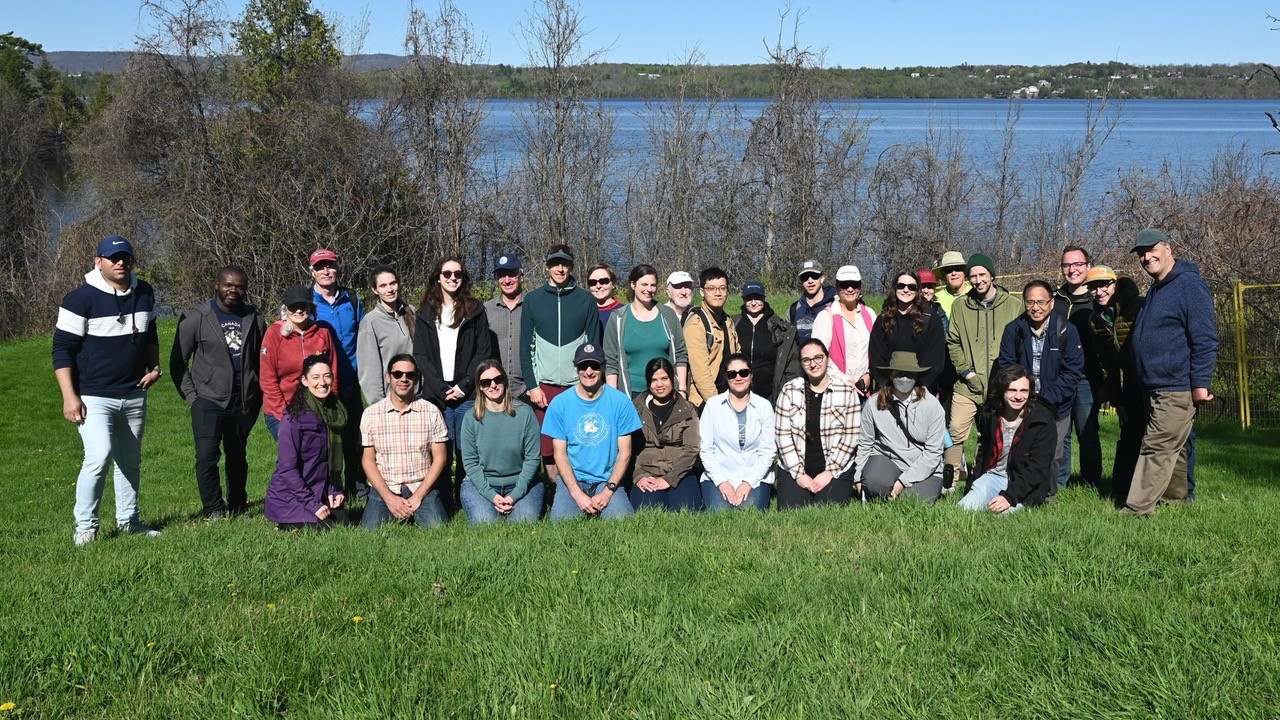
GSC field trip participants wrapped the day at Pinhey’s Point on the Ottawa River.

GSC field trip participants wrapped the day at Pinhey’s Point on the Ottawa River.

The day began with a series of context-setting presentations at the University of Ottawa on various modelling approaches, from satellite gravimetry to hydrostratigraphic and integrated groundwater–surface water modelling.


From there, the group headed west to the GSC’s National Borehole Calibration Site, where participants got in-depth explanations of the various tools and technologies used — and in some cases, developed — by the GSC team, including downhole geophysical logging, nuclear magnetic resonance, passive seismic microtremor and larger-scale seismic monitoring, Med-CT scanning and core flooding for bedrock analysis, and more.


The final stop of the day was bankside on the Ottawa River at Pinhey’s Point for presentations on seismic stratigraphy, groundwater monitoring, Champlain Sea porewaters, and waterborne seismic imaging of river and lake sub-bottoms.


The tour impressed attendees with the depth of innovation behind GSC’s groundwater work and how that innovation is helping generate fuller insights into local groundwater resources.

Stay in touch

Reach out by email and follow us on social:

Copyright © 2025 Aquanty Inc., All rights reserved.
Aquanty Inc., 600 Weber St.N., Unit B, Waterloo, ON N2V1K4, Canada, (519)-279-1080 [email protected]

Want to change how you receive these emails?
You can update your preferences or unsubscribe from this list.

If you would like to unsubscribe, please click here.