͏‌ ͏‌ ͏‌ ͏‌ ͏‌ ͏‌ ͏‌ ͏‌ ͏‌ ͏‌ ͏‌ ͏‌ ͏‌ ͏‌ ͏‌ ͏‌ ͏‌ ͏‌ ͏‌ ͏‌ ͏‌ ͏‌ ͏‌ ͏‌ ͏‌ ͏‌ ͏‌ ͏‌ ͏‌ ͏‌ ͏‌ ͏‌ ͏‌ ͏‌ ͏‌ ͏‌ ͏‌ ͏‌ ͏‌ ͏‌ ͏‌ ͏‌ ͏‌ ͏‌ ͏‌ ͏‌ ͏‌ ͏‌ ͏‌ ͏‌ ͏‌ ͏‌ ͏‌ ͏‌ ͏‌ ͏‌ ͏‌ ͏‌ ͏‌ ͏‌ ͏‌ ͏‌ ͏‌ ͏‌ ͏‌ ͏‌ ͏‌ ͏‌ ͏‌ ͏‌ ͏‌ ͏‌ ͏‌ ͏‌ ͏‌ ͏‌ 
Is this email not displaying correctly? View it in your browser.
CEE logo on white background with the text Collaboration for Environmental Evidence

CEEConnections

Issue 3 - December 2025

In this issue
From the Executive Office

Community Spotlights

From Our Teams and Centres

From the Journal

From the Executive Office

CEE Welcomes a New Board Member!

     In November, Dr Luvuyo Jalisa from the University of Johannesburg’s Department of Anthropology and Development Studies joined CEE as a Board Trustee. His work bridges research and community-based evidence to advance equitable, sustainable and inclusive water governance. We are excited to have his expertise guiding CEE’s work to strengthen evidence synthesis and the use of environmental evidence in decision-making.

🔗 Read more about our Trustees

Photo of of Dr Luvuyo Jalisa beside text announcing his welcome to the Collaboration for Environmental Evidence Board of Trustees, with the organization’s logo at the bottom right.
Image description

It is with deep gratitude that CEE recognises two of our volunteers for their service and dedication to our work and mission.


     Professor Ruth Stewart is stepping down as a Trustee after seven years of service on the CEE Board. As a Trustee, Ruth offered steady guidance, thoughtful challenge and commitment to CEE’s mission. Through leadership roles with the Africa Centre for Evidence and the Africa Evidence Network, among others, she brought deep experience in connecting research, policy and practice that greatly strengthened CEE’s work. We look forward to engaging with her in other capacities in the years ahead.


     Dr Barbara Livoreil is concluding three years as the CEEDER Manager and Team Lead. Based in France, Barbara supported a team of more than 80 volunteers and oversaw the addition of more than 1000 critically appraised syntheses to the database. She introduced new processes that increased efficiency, developed a CEEDER training platform, launched the CEEWatch video series featuring conversations with people involved in creating and using environmental evidence syntheses, and strengthened collaboration among CEEDER volunteers. We are grateful for her dedication and contributions to this important CEE activity and look forward to staying connected with her in new roles.

Community Spotlights

CEE Co-Publishes Statement on the Use of AI in Evidence Synthesis

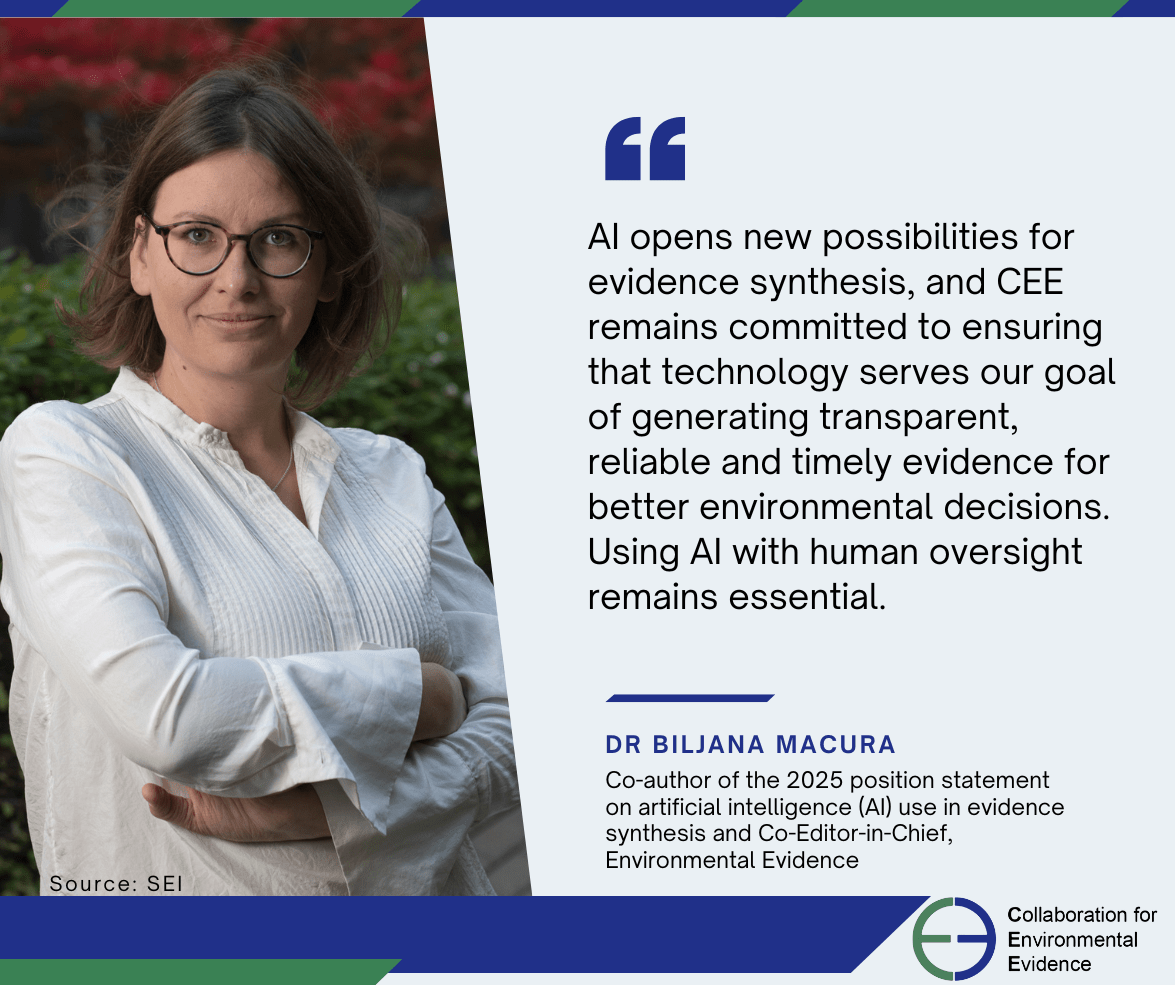
     In November, CEE joined leading organisations in evidence synthesis to release a statement on the responsible use of artificial intelligence (AI) in evidence synthesis. The authors, all members of the Joint AI Methods Group, include Dr Biljana Macura, co-Editor-in-Chief of Environmental Evidence and Dr Matthew Grainger, CEE Board Member. The statement supports Responsible use of AI in evidence SynthEsis (RAISE) recommendations and lays out shared expectations across CEE, Cochrane, the Campbell Collaboration and JBI for the use of AI in our journals.


Photo of Dr Biljana Macura with a quote about AI use in evidence synthesis emphasizing the need for human oversight.


     Published simultaneously in Environmental Evidence, Cochrane Database of Systematic Reviews, Campbell Systematic Reviews and JBI Evidence Synthesis, the statement calls for human oversight, transparency and clear justification whenever AI is used in the conduct of evidence synthesis. Through our work with the Joint AI Methods Group, CEE remains committed to ensuring that the members of our community have the resources and guidance needed to use AI responsibly, efficiently and equitably within their evidence syntheses.


🔗 Read the full statement in Environmental Evidence

A New Phase for the Evidence Synthesis Infrastructure Collaborative

     Exciting news is coming out of the Evidence Synthesis Infrastructure Collaborative (ESIC). If you’ve been following along with our posts and newsletters this year, you may remember that Wellcome Trust funded a year-long collaborative planning process that culminated in the ESIC Collaborative Roadmap to achieve “faster learning from the best available evidence for better results.” Now the first foundational investments are coming online to support sectoral and regional hubs, open data systems and living evidence synthesis tools. 


One of the first major investments aligned with the Roadmap is a new UK-led project, Mobilising Evidence Through Artificial Intelligence and User-Informed Synthesis (METIUS), funded by UK Research and Innovation through the Economic and Social Research Council and the Natural Environment Research Council with co-funding from the Department for Science, Innovation and Technology. This £11.5 million project will improve the speed, relevance and accessibility of evidence synthesis for decision-makers addressing urgent challenges, including environmental priorities. CEE is involved in one of the work packages through its engagement with the UK cross-government environmental evidence synthesis community of practice.


Watch the ESIC website for more information as these exciting developments come online.


Want to learn more?

Join the ESIC Update Webinar

🗓 18 December 2025 from

14:00 – 15:00 (UTC)

🔗 Registration link

ESIC logo

From Our Teams and Centres

Upcoming Training Opportunity

     Professor Ruth Garside and a team of leading experts in evidence synthesis at the University of Exeter are offering a training in Systematic Reviews of Mixed Methods. The University of Exeter and Harper Adams University together form the UK CEE Centre. Ruth is the Centre contact at Exeter and also leads the CEE Training Team.

🗓️ Dates: 28-29 January 2026

Prerequisites: Participants must have prior systematic review experience and knowledge of Qualitative Evidence Synthesis.

🔗Registration link

Graphic containing registration details for a University of Exeter training course on systematic reviews

Participate in the CEEDER User Survey

Last Call! The CEEDER Team wants your input as they plan for the future of the CEE Database of Evidence Reviews. (We’ve fixed the respondent link that was in the last newsletter!) Whether you’re a regular user or are hearing about CEEDER for the first time, please take five minutes to help us improve this service for our community. The survey will close 19 December.

Take the survey!

From the Journal

Environmental Evidence is published by Springer Nature

Now Inviting Evidence in Action Articles

     Did you know that Environmental Evidence, our open-access journal, publishes Evidence in Action articles that explore the broader issues surrounding the production and communication of evidence syntheses?


     Evidence in Action Analysis articles involve rigorous qualitative or quantitative analyses of how environmental decisions are made, the role of evidence synthesis on policy making, and other aspects of evidence generation, evidence synthesis, or environmental decision-making.


     Evidence in Action Perspective articles typically feature discussions of the impact of evidence-based practice on environmental managers, the influence of evidence synthesis on policy making or developments at the science-policy interface.

🔗 Learn more

Recently published

New Evidence Syntheses and Protocols

Identifying and addressing the anthropogenic drivers of global change in the North Sea: a systematic map

Alexandra M. Blöcker, Dominik Auch, Helene M. Gutte, Johanna Biederbick, Rémy Asselot, Leonie Färber, Gregor Börner, Elvis Kamberi, Frane Madiraca, Claudia Ofelio, Laurin Steidle & Fabien Moullec

https://doi.org/10.1186/s13750-025-00377-2


What evidence exists on the effectiveness of algae as biomonitors of pollution in estuaries? A systematic map protocol
Daniel Tremmel, Carla Carvalho, Túlio Silva, Jana Del Favero & Bruno Guides Libardoni
 

https://doi.org/10.1186/s13750-025-00378-1


What is the nature of evidence regarding relationships between urban agriculture and gentrification? A systematic map protocol

Anton Parisi, Beatrice Walthall, Paola Clerino, Paula Firmbach, Monika Onyszkiewicz & José Luis Vicente Vicente

https://doi.org/10.1186/s13750-025-00375-4


What evidence exists for the impact of restoration of natural processes on biodiversity in temperate ecosystems: a systematic map protocol

Kerstin Bouma, Pablo Villalva Aguilar, Siri Vatsø Haugum, Bjarke Madsen, Urs Albert Treier, Signe Normand, Carsten Rahbek & Jacob Heilmann-Clausen

https://doi.org/10.1186/s13750-025-00373-6


Braiding traditional ecological knowledge and Western science in the management of freshwater social-ecological systems: a systematic map protocol

Ronald J. Maliao & Béla Tóthmérész

https://doi.org/10.1186/s13750-025-00371-8


What evidence exists on how biodiversity is affected by the adoption of carbon footprint-reducing agricultural practices? A systematic map

Stuart Rowlands, Julia Casperd, Michael R. F. Lee, Scott Kirby & Nicola Randall

https://doi.org/10.1186/s13750-025-00372-7


What evidence exists on the interlinkages between ecological and societal impacts of borealisation of the arctic? A systematic map protocol

Kate Baker, Vera Helene Hausner, Jennifer Ramsay & Helen C. Wheeler

https://doi.org/10.1186/s13750-025-00367-4

New from the AI Special Collection

Spanish-language text classification for environmental evidence synthesis using multilingual pre-trained models

Violeta Berdejo-Espinola, Ákos Hajas, Richard Cornford, Nan Ye & Tatsuya Amano

https://doi.org/10.1186/s13750-025-00370-9


Advocating for trust in and trustworthy AI to transform evidence synthesis

Isabel K. Fletcher

https://doi.org/10.1186/s13750-025-00369-2

Special Collection: The current and future use of artificial intelligence for systematic evidence synthesis in environmental management

Browse the collection
Image description

CEE is deeply grateful to our volunteers and partners, whose time and expertise support all aspects of our work. With no paid staff and a modest budget, their dedication allows our organisation to deliver global-scale impact. Thank you for being a valued part of our community!

JOIN OUR MAILING LIST

Copyright © 2025 Collaboration for Environmental Evidence

Newsletter Editor: Natalie Dubois

AI Disclosure: The ideas and primary text in this newsletter are the work of human authors. We may use AI tools to assist with editing, but our human review team reads and approves all final content.

If you would like to unsubscribe, please click here.