The Ticking
Ali Ives
Urban Fantasy
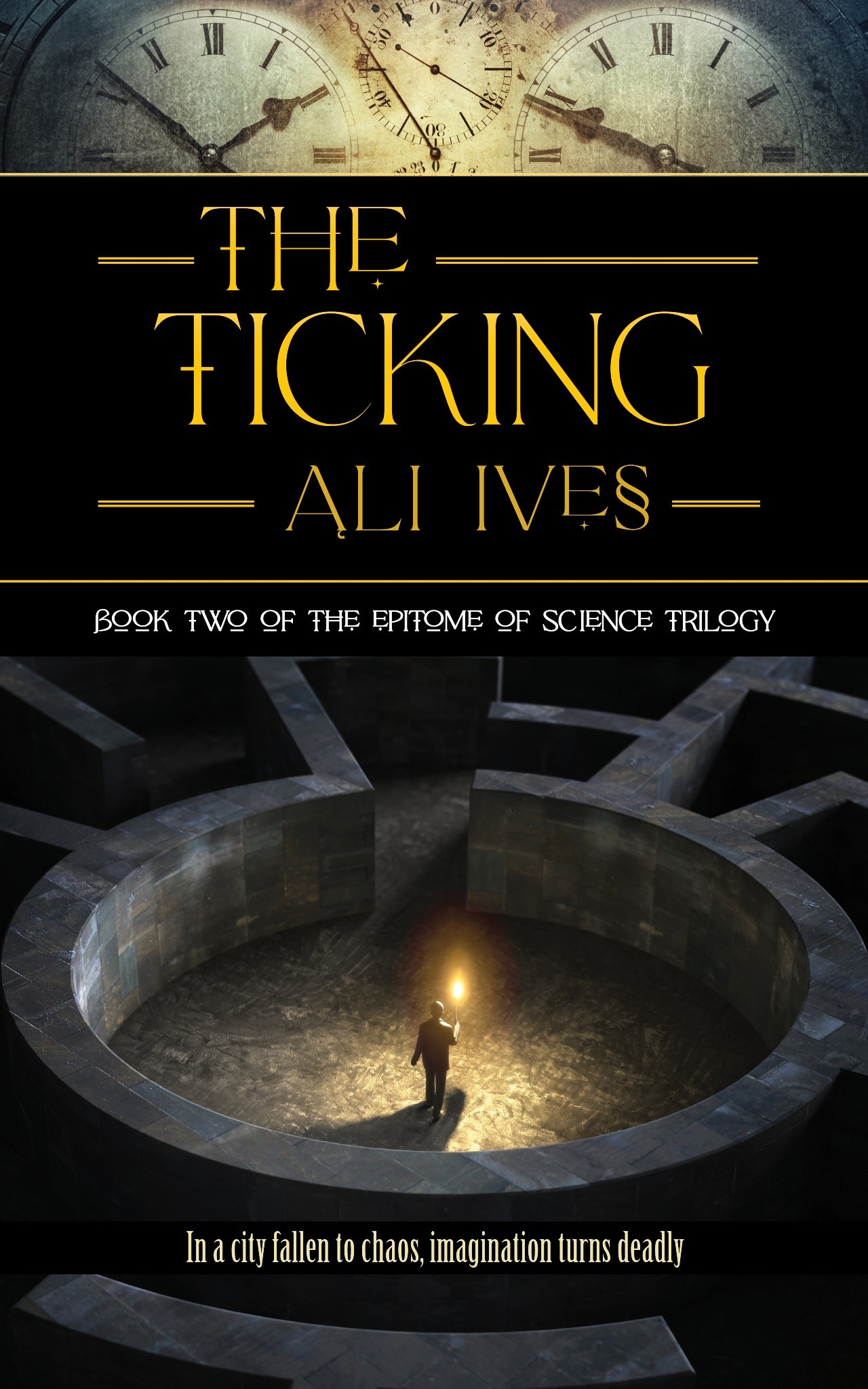
In a city fallen to chaos, imagination turns deadly.
In this exciting sequel to The Winding, everyman-turned-hero Mikalai Gloucester finds himself swimming far out of his depths.
Two weeks have passed since Denken, a vicious demigod with the power to manipulate human thought, disappeared in the wake of a shocking confrontation. Unleashed upon the city of Frettchen, his magic sows fear and paranoia into the minds of all.
Worse, a horde of nightmarish creatures once locked safely away in Denken’s pocket dimension now roam free. Though Mikalai Gloucester has no magic of his own, he is determined to fight the beasts alongside his new friends, a motley band of magicians, scientists, and unusual beings.
Distrust threatens to tear them apart, but the group must work together to save one of their own and discover Denken’s plan for the city. It’s a race against the ticking clock to stop him before he destroys Frettchen for good.
INTERVIEW WITH ALI IVES
Can you describe what your book is about in one sentence?
The Ticking tells the story of the fallout of The Winding, as magic runs amok through the city of Frettchen and monsters begin to stalk the city streets.
What is the theme of The Ticking?
I said for The Winding that the main theme was probably trust, and I do think that carries over in The Ticking: trust in others and, more than anything, trust in yourself. I think in both books there's a strong theme of agency, too. Gloucester is a character who begins his story with very little agency and thus fights to regain it. In The Ticking, he struggles with feelings of powerlessness in the face of magic and seemingly insurmountable odds, and I like to think that intertwined theme of agency and trust is portrayed through his arc: he has to trust himself and stand his ground on his own choices, which have more power than he realizes.
How do you develop your plots and characters?
Generally speaking, rather on the fly. A good number of the characters in the Epitome of Science trilogy started out as drawings all the way back in high school. I'd played around with the idea of doing a comic with them, but at the time, I never had enough of a story to do much with it. It wasn't until years later that Gloucester popped into my head and with him, the idea for this story. Since then, the storylines and character development sort of just unfolds as I write. I try not to force anything and just let characters and plot alike form organically.
What was your favorite part of writing The Ticking?
There are some new characters introduced in The Ticking that were a lot of fun to write. There's also a lot more exploration of magic in this one. I love writing the magical elements of these books, so that was really great.
Give us some insight into your main character. What does he do that is special? What are his character flaws?
Mikalai Gloucester is a shy, awkward fellow who is far more brave than he thinks himself to be. He doesn't see himself as a hero, but he's also quick to come to people's defense when they're in need and doesn't like to run from a fight. I think what makes him special is the way he always has questions running through his head; he's a puzzle-solver, constantly turning problems over and over in his mind in search of answers and better understanding. Sometimes this is really helpful, since he's pretty smart and can come up with some pretty good ideas. Other times it works to his detriment, making him second-guess situations and overthink a lot of things. He's quite socially awkward, but I think perhaps not as much of a lost cause as he believes. Despite his reluctance to trust others, he does try and see the best in people.
Tell us about the conflict in this book. What is at stake for your characters?
After the events of the first book, the city of Frettchen is in more danger than ever. Denken's powers are unstable and his violent act at the end of The Winding has unleashed nightmarish consequences. Our heroes have to figure out how to stop Denken and the monsters that have started appearing in the city, before the demigod's powers grow too strong for anyone in the human world to contend with.
What was one of the most surprising things you learned in creating The Ticking?
I always sort of thought that writing the middle part of a trilogy would be sort of a slog, because I used to struggle most with writing the 'in-between' scenes when I was younger – the scenes leading up to the exciting bits. What writing The Ticking made me realize is that those 'in-between' scenes can be the most fun and rewarding. They're where a lot of character and lore exploration can happen. I surprised myself in learning just how much more fun I could have writing when I indulged in some patience and just really allowed myself to write the building of plot, not just the showy starts and finishes.